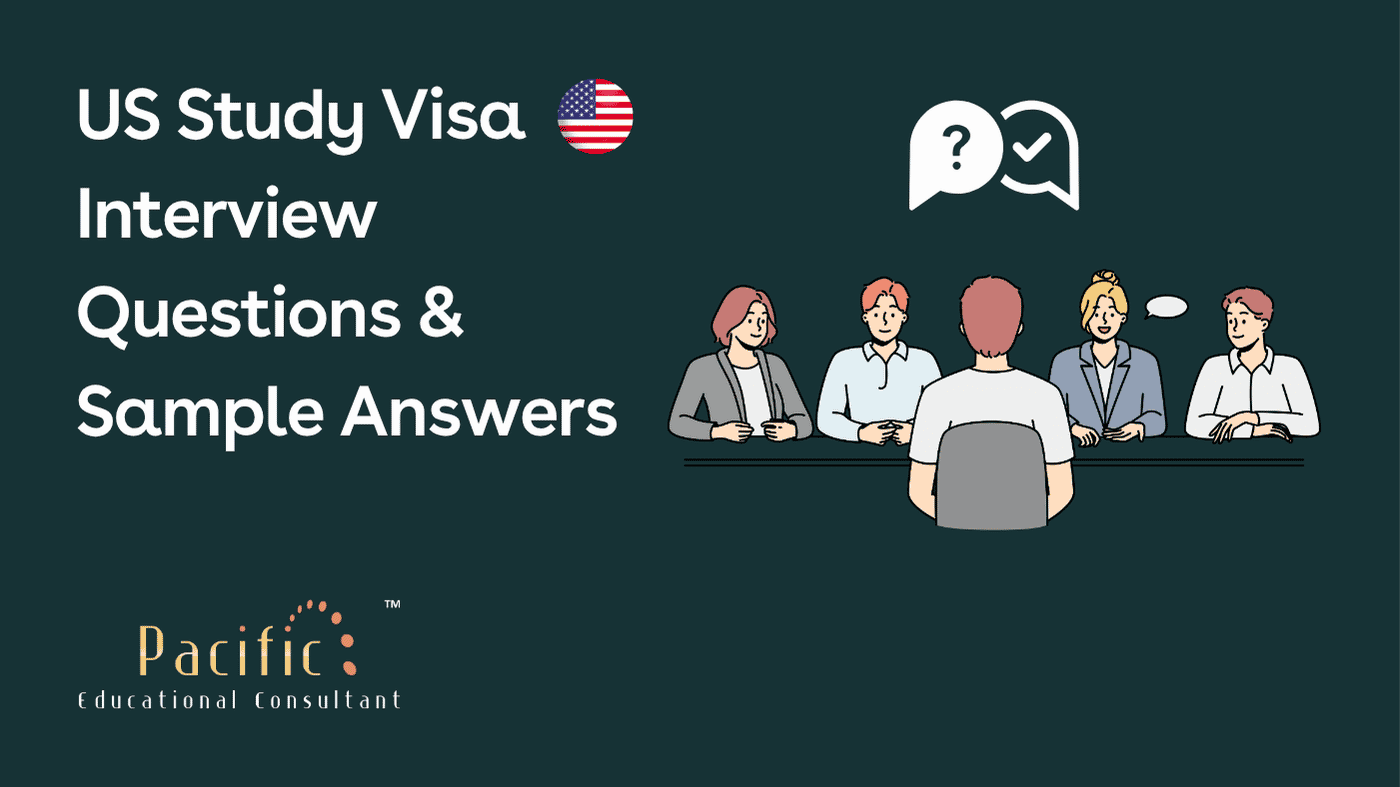
If you have an I-20 in hand and a consulate slot booked, the US study visa interview questions you face in the next two to three minutes now matter more than your entire application file. In 2025, 61% of Indian F-1 applicants were refused — the highest rate in a decade. This guide gives you the real questions asked in 2026, category by category, with sample answers written for Indian students and the exact logic officers use to judge every reply.
| Quick answer: US study visa interview questions fall into five areas — your course, your university, your finances, your post-study plans, and your ties to India. A consular officer spends just two to three minutes deciding whether you are a genuine student who will study and then return home. Answer with specific, honest, India-anchored replies you can back up with documents. |
This article focuses purely on the questions and how to answer them. For the full fee breakdown, documents checklist, dress code and a readiness scorecard, read our complete US study visa interview preparation guide. To pick programmes and universities first, see our study in the USA guide for Indian students.
Behind every question sits one legal test: Section 214(b) of the US Immigration and Nationality Act. It presumes you intend to immigrate — and it is your job to disprove that in a few sentences. The officer is deciding one thing: are you a genuine, funded student who will return to India, or a likely overstay?
That is why the same answer can pass or fail depending on framing. "I'll look for a job in the US after graduation" reads as immigrant intent. "I plan to return and join my family's business with a US-qualified skill set" reads as a genuine student. The facts can be identical; the framing is what the officer scores.
Three filters run in the officer's head as you speak: Is this student genuine? Can they pay? Will they leave? Map every answer to at least one of those and you are already ahead of most applicants.
A few recent shifts change how you should prepare, even though they don't change the questions much:
| 💡 Pacific Educational Consultant Insight: Officers judge your first ten seconds before you finish your first answer. In our mock interviews, the students who get refused rarely fail on facts — they fail on hesitation, a rising "immigrant" tone, or a rehearsed voice. Walk up, greet clearly, hand over documents only when asked, and answer the actual question in one breath before adding proof. Confidence with brevity beats a perfect script delivered nervously. |
Most refused answers are either too vague or too long. Use this simple structure for almost any question:
Example — "Why this university?" Answer: "I chose Arizona State University for its MS in Information Technology." Proof: "It has a project-based curriculum and a strong cloud-computing lab, and my admit came with a partial scholarship." Anchor: "That specialisation is exactly what India's growing fintech sector is hiring for." Three layers, under 20 seconds, all three of the officer's filters answered.
Below are the most common F-1 visa interview questions and answers for 2026, grouped the way officers actually ask them. Treat the sample answers as templates to personalise, never scripts to memorise.
These test whether you are a real student who made an informed choice.
Q: Why do you want to study in the USA? Sample answer: "The US offers the strongest programmes in my field with hands-on research and industry exposure I can't get at home. My specific course combines coursework with a practicum, which fits my goal of becoming a specialist in [field]." Tie it to your career, never to "better life" or "opportunities to settle."
Q: Why did you choose this course/major? Sample answer: "I studied [subject] in my bachelor's and scored [X]. This master's deepens exactly the area I want to build a career in — [specialisation] — which is why I chose it over a general programme."
Q: What are your test scores? Know your IELTS/TOEFL and GRE/GMAT/SAT numbers exactly. "IELTS 7.5 overall, GRE 318" — no fumbling. Strong English delivery matters here as much as the score; our IELTS Academic coaching and TOEFL iBT preparation build exactly the fluency officers listen for.
Q: Why not study this course in India? Sample answer: "India has good programmes, but the specific specialisation and the research facilities in my chosen course aren't available at the same depth here. The US degree gives me a skill set I can bring back and apply." Respect Indian education; explain the specific gap you're filling.
| The officer asks | What they want to hear | Avoid |
| Why this university? | Specific reasons — faculty, curriculum, ranking, labs | "It's famous" / "It's easy to get in" |
| How many universities did you apply to? | A short, honest number and your reasoning | Naming 15 random schools |
| How many admits and rejects? | Straight facts, no defensiveness | Hiding rejections |
| Do you know anyone there? | A truthful yes/no; a classmate is fine | Implying you'll depend on relatives |
| What do you know about the city/location? | Basic awareness of campus and area | "I haven't checked" |
Sample answer — "Why this university over the others you got into?" "I picked [University] because its [specific program feature] matched my goals best, and the total cost fit my funding plan. The other admits were strong too, but this was the best fit academically and financially."
This is where vague answers sink applications. Carry clean bank statements and know your exact figures.
Q: Who is sponsoring your education? Sample answer: "My father is my primary sponsor, supported by an education loan of ₹[amount] from [bank]." Be specific about the sponsor and the split.
Q: What is your sponsor's occupation and annual income? Know the number. "My father runs a textile business with an annual income of about ₹[X] lakh, and we have savings and the sanctioned loan to cover the full first-year cost on my I-20."
Q: What is the total cost of your program, and how will you cover it? Sample answer: "The first-year cost on my I-20 is about $[X]. It's covered by my education loan of ₹[amount], family savings, and a partial scholarship of $[amount]." Match your numbers to the I-20 exactly.
Q: Have you taken an education loan? How much? State the sanctioned amount, the bank, and that the sanction letter is with you. A sanctioned loan is strong evidence of funding capacity.
| 💡 Pacific Educational Consultant Insight: The single most common funding refusal we see isn't too little money — it's unexplained money. A large deposit that landed in the account two weeks before the interview reads as an arranged balance. Keep a clear paper trail for any big recent credit (property sale, FD maturity, loan disbursal) and be ready to name its source in one sentence. If your funding story or academic narrative needs sharpening, a well-structured Statement of Purpose written with Pacific's SOP experts keeps your documents and your spoken answers aligned. |
This category decides most Indian refusals. The officer is openly testing whether you'll leave.
Q: What are your plans after graduation? Sample answer: "After my degree I plan to return to India and work in [specific sector], where my specialisation is in demand. I may use OPT briefly to gain practical experience first, but my long-term career is in India." Honest, specific, India-anchored.
Q: Will you come back to India? Sample answer: "Yes. My family, my long-term career plans and [specific tie — a family business, a job market you're targeting, property] are all here. The US degree makes me more valuable in India."
Q: Do you plan to work in the US? Don't deny OPT exists — that sounds evasive. Sample answer: "I'm aware I can do authorised practical training if eligible, and I may use it to apply what I've learned, but my primary purpose is education and my plan is to build my career back home."
Q: Why should I believe you'll return when so many students stay? Sample answer: "Because my plan only works in India — [specific reason]. My degree is a means to a career here, not a way to relocate." Stay calm; this is a pressure test, not an accusation.
| 💡 Pacific Educational Consultant Insight: The "return to India" answer fails when it's abstract. "I love my country" convinces no one. What works is a concrete, checkable anchor: a family business you'll join, a specific industry hiring in your city, a parent's practice you'll inherit, land or property in your name. Name one real anchor and stop — over-explaining your loyalty is itself a red flag. Never volunteer interest in a US job, green card, or "settling." You don't have to lie; you have to lead with your genuine India-facing plan. |
| Question | How to handle it |
| Do you have relatives in the USA? | Answer truthfully. Hiding a relative the officer can see on record is far worse than the relative itself. |
| Are you married / do you have a spouse or children? | State the facts plainly; mention if your spouse stays in India (a strong tie). |
| Has any visa (US or other) ever been refused? | Disclose honestly — refusals are on record. Briefly note what changed since. |
| Have you travelled abroad before? | Yes/no; prior compliant travel that you returned from helps you. |
| What will you do if your visa is refused? | "I'll understand the reason, strengthen my case, and reapply." Never argue. |
| Question theme | ✅ Green-flag answer | ❌ Red-flag answer |
| Why the USA | "Best programme for my specific career goal" | "More opportunities / better life there" |
| Funding | Exact figures matched to the I-20 | "My father will manage it somehow" |
| After graduation | "Return to India to work in [sector]" | "I'll find a job and see how it goes" |
| Relatives in US | Honest disclosure | Concealment the officer can verify |
| University choice | Faculty, curriculum, cost-fit | "It was the only one that accepted me" |
Most F-1 interviews are short — often 90 seconds to three minutes, and the officer usually asks only five to eight questions before deciding. New student visas issued globally fell by around 36% between summer 2024 and summer 2025, so demand is high and appointments move fast: your answers, not your document stack, carry the interview.
|
Key Takeaways
|
How many questions are asked in a US student visa interview?
Usually five to eight, over 90 seconds to three minutes. Officers decide quickly, so each answer should be specific and self-contained rather than long.
What is the best answer to "Why do you want to study in the USA?
Tie it to your career and to your specific course — the programme structure, research or faculty — not to "better opportunities." End with how the US skill set fits your plan back in India.
How do I answer "Will you return to India?" without sounding rehearsed?
Name one real, checkable anchor — a family business, a target industry in your city, property, or a parent's practice — then stop. Concrete beats emotional. Avoid the words "settle" or "PR."
Should I memorise my visa interview answers?
No. Officers are trained to spot scripted delivery, and memorised answers are a known refusal trigger. Prepare the ideas using the 3-Part Formula and practise out loud so they sound natural.
Which questions cause the most F-1 rejections for Indian students?
The post-study and funding questions. Vague finances and any hint of immigrant intent under Section 214(b) are the top reasons Indian applicants are refused.
What if I don't understand or don't know the answer to a question?
Politely ask the officer to repeat or rephrase. If you genuinely don't know, say so briefly and honestly — guessing or bluffing does more damage than a simple "I'm not certain."
Can I answer the US visa interview in Hindi?
Interviews are generally conducted in English, and your fluency is part of what's being assessed. Answer in clear, simple English; you don't need advanced vocabulary, just clarity and confidence.
Are US study visa interview questions different in 2026?
The core questions are the same, but expect awareness of new realities — public social media profiles, and the fact that in-person interviews are again mandatory. If asked about your stay length, answer with the program dates on your I-20.
The questions rarely change — but how you answer them is what separates an approval from a 214(b) refusal. If you'd like a real mock interview, an honest review of your funding story, and answers tailored to your profile, our counsellors can help end-to-end through our expert US student visa assistance.
👉 Book your free counselling session and walk into your interview ready to answer with confidence.

Book a Free Counselling

Welcome to Pacific Educational Consultant and Classes, your trusted partner in unlocking a world of educational opportunities and personal growth.


© 2026 Pacific Educational Consultant. All rights reserved
 Canada
 United States
 United Kingdom
 Australia
 Germany
 France
 Netherlands
 New Zealand
 PTE
PTE
 IELTS General Training
 TOEFL iBT
 Duolingo English Test
 SAT
SAT
 GRE
GRE
 GMAT
GMAT
 SPOKEN ENGLISH
 SOP Writing
 Air Tickets
 Accommodation
 Career Counselling
 Visa Assistance