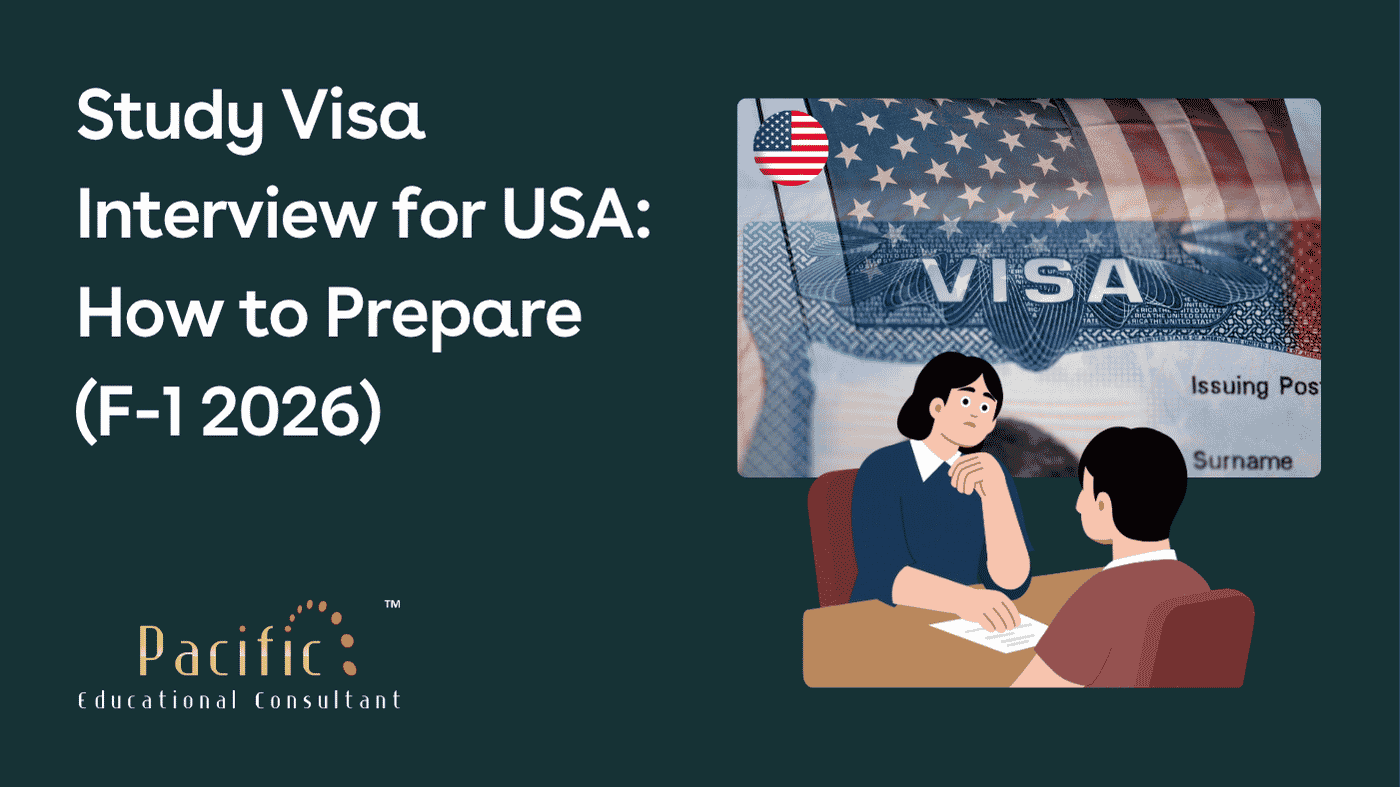
The study visa interview for USA is the single step that decides whether your American dream becomes a boarding pass or a green refusal slip. For Indian students, it is short, high-pressure, and often over in under three minutes — which is exactly why preparation matters. This guide walks you through the F-1 documents, real interview questions, the new 2025–26 rules, and a counsellor-tested framework to help you walk in ready and walk out approved.
| Quick Answer: To prepare for a study visa interview for USA, pay your SEVIS and DS-160 fees, book your slot early, and organise your I-20, passport, financial proof and admission letter. Practise concise 20–30 second answers on why this course, this university, your funding, and your plan to return to India. Stay honest, calm and consistent. |
The F-1 is the non-immigrant visa that lets you study full-time at a US institution certified by the Student and Exchange Visitor Program (SEVP). The interview is the final checkpoint before your visa is stamped.
A consular officer has one core job: to decide whether you are a genuine student who will study and then return home — or someone likely to overstay. Consular officers now have less than three minutes per case on peak days, making concise, evidence-backed answers essential.
This matters more than ever. The share of Indian F-1 applicants the United States refused in 2025 was 61 percent, the highest rate in a decade and up from 53 percent in 2024. A strong file and a confident interview are the parts you can actually control.
Before the interview, three or four separate fees must be paid — and Indian students routinely under-budget them because one of them is brand new.
| Fee | Amount (USD) | Approx. INR* | Paid To | Refundable? |
| DS-160 / MRV application fee | $185 | ≈ ₹16,300 | US Dept. of State | No |
| SEVIS I-901 fee | $350 | ≈ ₹30,800 | US DHS (fmjfee.com) | No |
| Visa Integrity Fee (new) | $250 | ≈ ₹22,000 | US govt. (at issuance) | Treat as non-refundable |
| Form I-94 fee | $24 | ≈ ₹2,100 | US govt. | No |
| Total | ≈ $785–809 | ≈ ₹70,000+ | — | — |
*INR figures are approximate and move with the exchange rate.
An F-1 visa applicant must pay $785 ($185 MRV fee + $350 SEVIS fee + $250 Visa Integrity Fee + $24 Form I-94 fee). The $250 Visa Integrity Fee was introduced under the One Big Beautiful Bill Act, signed on July 4, 2025, and took effect from October 1, 2025.
On timing, plan backwards from your intake. Securing an interview date and completing the US student visa process will take approximately 2-3 months. Appointment supply changes fast around intake deadlines, so book the moment you receive your I-20. You can explore programmes and universities first through our study in the USA guide for Indian students.
Carry originals plus one clean photocopy set. Missing paperwork is the easiest, most avoidable refusal.
Mandatory documents
Supporting documents (keep ready, show if asked)
You must show ability to fund tuition fees, living expenses, and travel costs, using personal or sponsor bank statements for the last 3–6 months, an education loan approval letter, or income proof
If your funding story or academic narrative needs sharpening, a well-structured Statement of Purpose written with Pacific's SOP experts keeps your application and interview answers aligned.
Here is the exact sequence we take Pacific students through.
1. Finish the paperwork correctly. Complete the DS-160 carefully — every detail must match your I-20 exactly (name spelling, course, university, dates). Once submitted, the DS-160 is locked; to correct information you must start a new one, so double-check before you hit submit.
2. Pay fees and book early. Pay SEVIS, then the MRV fee, then schedule. Early slots give you buffer time and reduce last-minute panic.
3. Master your own file. Know your funding numbers, your programme's duration and modules, and why you chose your specific university — not a generic "USA has good education" answer.
4. Practise out loud, in English. Rehearse crisp 20–30 second answers. Record yourself. Fix filler words and rambling. Solid English proficiency helps here — our IELTS Academic coaching and TOEFL iBT preparation build exactly the fluency officers listen for.
5. Do a mock interview. A realistic dry run with a counsellor exposes the weak answer you didn't know you had.
Every officer's question maps to one of five themes. Prepare a tight, honest answer for each "C" and you've covered ~90% of what you'll be asked.
| The "C" | What the officer is really asking | Your job |
| Course | Is this study plan genuine? | Explain why this specific programme fits your background |
| College | Why this university, not just any admit? | Name real reasons — faculty, curriculum, ranking, research |
| Country | Why the USA? | Tie it to your career goal, not to migration |
| Cost | Can you actually fund this? | State your sponsor, amount and source clearly |
| Comeback | Will you return to India? | Show ties — family, career plans, opportunities back home |
| 💡 Pacific Educational Consultant Insight: The "Comeback" C is where most Indian refusals happen under Section 214(b). Never volunteer interest in a US job, PR or "settling." When asked about the future, anchor it in India — a family business to join, a specific industry back home, or a role your US degree qualifies you for here. You don't have to lie; you have to lead with your genuine India-facing plan. |

Officers group questions into predictable buckets. The average student visa consular interview lasts between 90 seconds to three minutes, so it is your job to convince the officer that you are qualified in this short amount of time.
Answer with specifics. "I chose this MS in Data Science because of Professor X's work and the co-op programme" beats "American universities are the best."
Know your exact numbers. Vague funding answers are a top refusal trigger.
Keep it honest, brief and India-anchored. Don't over-explain.
This is the biggest recent change and catches students off guard. All applicants for F, M, and J nonimmigrant visas are instructed to adjust the privacy settings on all of their social media profiles to "public."
On June 18, 2025, the US Department of State issued expanded screening guidance; applicants must provide details about all online social media profiles used within the past five years, and content indicating hostility toward the United States may result in ineligibility.
The instinct to panic-delete everything usually backfires. If your accounts are currently private, update your settings early and avoid last-minute changes close to your interview; deleting posts or changing usernames overnight often does more harm than good. The theme is consistency — your online presence should match your application.
| 💡 Pacific Educational Consultant Insight: We now run a "digital footprint audit" for every US applicant before their interview. The three things we check first: (1) your DS-160 details match your LinkedIn and Instagram bios, (2) no abandoned duplicate accounts create confusion, and (3) nothing in your public activity contradicts your stated study intent. Start this cleanup at least 4–6 weeks before your slot, not the night before. |
Most refusals fall under Section 214(b) — failure to prove non-immigrant intent. The good news: nearly all of them are fixable with preparation.
| Common refusal reason | How to avoid it |
| Weak home-country ties (214b) | Lead with concrete India-facing career/family plans |
| Insufficient or unclear funding | Carry clean 3–6 month statements; know exact figures |
| DS-160 vs interview mismatch | Rehearse against your own form; keep answers consistent |
| Scripted, over-rehearsed answers | Practise the idea, not a memorised script |
| Large unexplained bank deposits | Keep a paper trail for any big recent credit |
| Vague or generic study plan | Use the 5-C Framework to sound specific |
Since June 2025, digital footprint inconsistencies have contributed to about 18% of refusals where they are noted as factors, alongside career-intent contradictions and financial-lifestyle mismatches.
If you've already faced a refusal, don't rush a reapplication. It is strongly advised not to reapply until your circumstances have changed significantly or you have new, compelling evidence to address the reason for the initial rejection. Our counsellors can help diagnose the exact weakness through our end-to-end US student visa assistance.
Presentation is part of the message. You should dress well, stay calm, be polite, and speak clearly in English.
Score yourself out of 10. Anything below 8 means you're not ready to book.
|
Key Takeaways
|
How long is the US study visa interview?
Most F-1 interviews last between 90 seconds and three minutes. Officers make a fast decision, so concise, specific answers matter far more than long explanations.
What questions are asked in the USA study visa interview?
Expect questions on your course and university choice, your major, who funds you and their income, your test scores, and your plans after graduation — especially whether you'll return to India.
Is the US student visa interview conducted in English?
Yes, F-1 interviews are generally conducted in English. This also helps the officer gauge whether your language skills are strong enough for your programme.
How much bank balance is required for a US F-1 visa?
There's no fixed universal figure — you must show you can cover the full first-year cost listed on your I-20 (tuition plus living expenses), typically evidenced through 3–6 months of statements, loan sanction letters or sponsor income proof.
Can I reapply after an F-1 visa rejection under 214(b)?
Yes, you can reapply at any time, but only after your situation genuinely changes or you have stronger evidence addressing the original refusal reason. Reapplying with the same file usually leads to the same result.
Do I need to make my social media public for the US visa?
Yes. Since mid-2025, F, M and J applicants are instructed to set all social media profiles to "public" and disclose handles used in the past five years. Set them public early rather than at the last minute.
What should I wear to the US visa interview?
Smart formal or business-casual attire. Look neat and professional, arrive early, and remember you cannot bring your phone or electronics into the consulate.
How early should I schedule my US visa interview?
Book as soon as you receive your I-20. Since the full process takes roughly 2–3 months and slots fill quickly around intakes, early scheduling protects your start date.

Book a Free Counselling

Welcome to Pacific Educational Consultant and Classes, your trusted partner in unlocking a world of educational opportunities and personal growth.


© 2026 Pacific Educational Consultant. All rights reserved
 Canada
 United States
 United Kingdom
 Australia
 Germany
 France
 Netherlands
 New Zealand
 PTE
PTE
 IELTS General Training
 TOEFL iBT
 Duolingo English Test
 SAT
SAT
 GRE
GRE
 GMAT
GMAT
 SPOKEN ENGLISH
 SOP Writing
 Air Tickets
 Accommodation
 Career Counselling
 Visa Assistance