

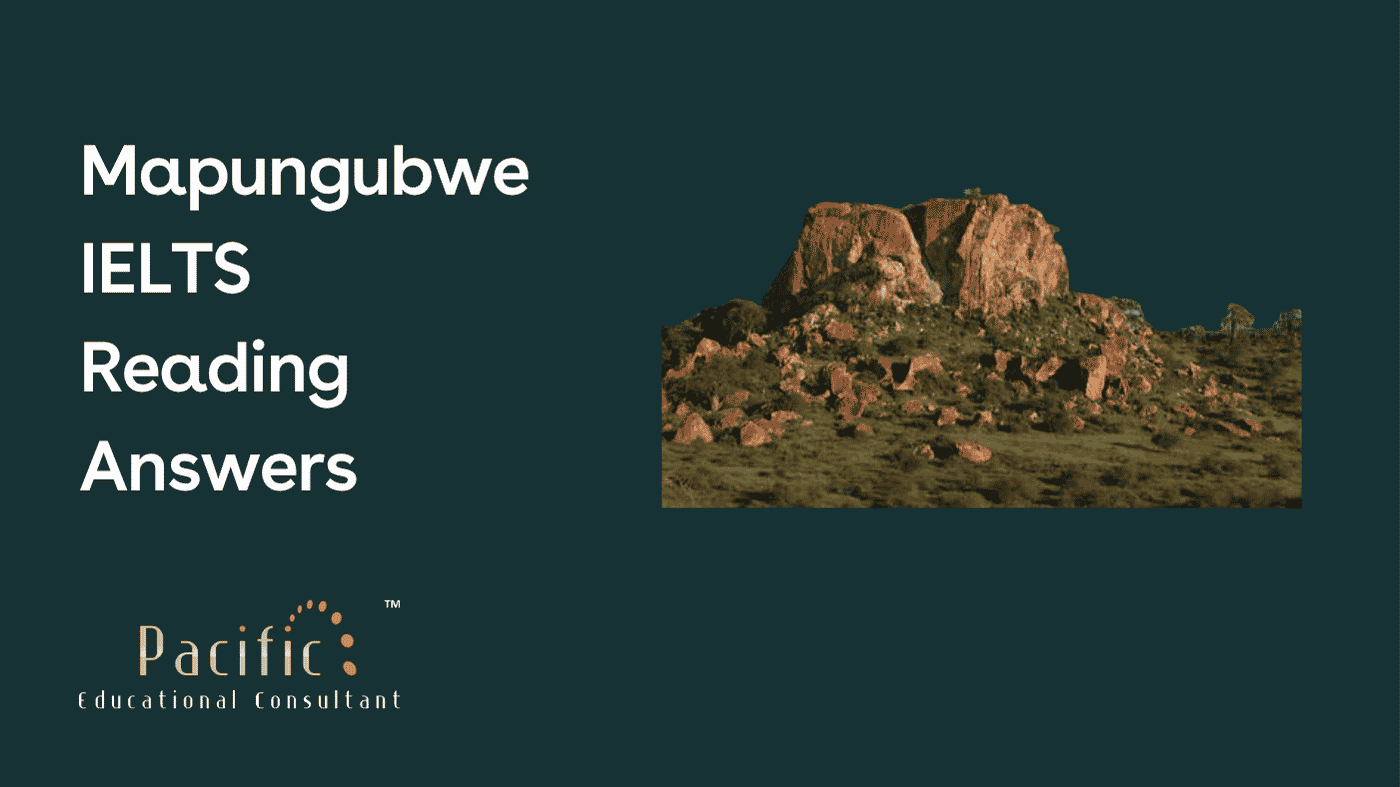
The Mapungubwe IELTS Reading passage describes one of the earliest kingdoms in southern Africa. It explores the community’s agriculture, social structure, trade, pottery, gold-working traditions and decline.
This IELTS Reading practice includes:
Attempt Questions 14–26 before checking the answer key.
Located in southern Africa, just below the Limpopo River, the kingdom of Mapungubwe flourished between the 11th and 13th centuries CE.
Mapungubwe was one of the first states in southern Africa. It was formed by Bantu-speaking peoples who were farmers.
The area controlled by its rulers had a large sandstone plateau at its centre. The plateau was easy to defend because it was difficult to access.
Cattle herding and other types of farming produced plenty of food. Surplus agricultural produce could be traded for other necessary goods.
Archaeological discoveries include extensive layers of bones and manure. These findings indicate that large cattle herds existed from the ninth century CE.
Cattle were traditionally considered a source of political power in southern African communities.
Archaeological evidence from the tenth century shows a significant increase in the number of domesticated cattle. Finds of spindle whorls also provide evidence of cotton cultivation and weaving.
At its peak in the middle of the 13th century, Mapungubwe had a population of approximately 5,000 people.
The chief or king was probably the wealthiest member of the community. He would have owned more cattle and valuable materials than anyone else.
The king and his advisers lived inside a stone enclosure on the highest part of the territory. The natural sandstone hill was approximately 30 metres high and 100 metres long.
Occupation of the hill dates from the 11th century. A wooden palisade surrounded the complex, as shown by postholes found in the rock.
The rest of the community lived in houses made from mud and thatch below the hill.
The settlement below the hill, known as Babandyanalo, covered approximately five hectares and existed before the hilltop buildings.
The kings of Mapungubwe were buried at the top of the hill in a clearly separated area away from the houses.
Other members of the community were buried at valley level.
A wooden staircase connected the two levels. The sockets for the steps can still be seen in the sandstone cliff.
Larger residences were located around the outskirts of Babandyanalo. These probably belonged to male relatives of the king.
Other smaller but impressive sites were situated between 15 and 100 kilometres from the main hill.
These sites contained stone walls and residences and probably belonged to local chiefs who served the king.
The Mapungubwe plateau contains many remains of carnivorous animals and pieces of ivory.
This suggests that animal skins and elephant tusks were collected for trade with coastal regions that could be reached through the Limpopo River.
Glass beads discovered at the site almost certainly came from India.
Their presence suggests that Mapungubwe traded with coastal states, which in turn traded with merchants travelling by sea from India.
Mapungubwe also benefited from locally sourced copper and the gold trade between Great Zimbabwe and coastal areas.
Trade links may have strengthened political authority because rulers wanted to control these profitable interregional connections.
Archaeologists discovered enough pottery to suggest that professional potters worked in Mapungubwe.
This provides further evidence of the prosperity of the society.
Finds include spherical vessels with short necks, beakers and bowls. Many of these objects were decorated with stamps.
Ceramic discs and whistles were also discovered.
Other objects include figurines of cattle, sheep and goats, along with small models of humans with elongated bodies and short limbs.
These figures may have been used in ceremonies as offerings to ancestors, but their exact purpose is unknown.
Archaeologists also found small jewellery items made from locally sourced copper.
Decorated gold objects have also been discovered at Mapungubwe.
A decorative technique found only in Mapungubwe and Great Zimbabwe involved forming gold into small rectangular sheets and carving geometrical patterns into them.
The sheets were attached to wooden objects using small gold tacks. The wooden objects have not survived.
One of the objects may have been a sceptre.
Other evidence of local gold-working includes a rhinoceros figurine made from hammered gold sheets and thousands of small gold beads.
The objects were discovered at the royal burial site and date to approximately 1150 CE.
They provide early evidence that gold had value in its own right rather than being valued only as currency.
Mapungubwe was already declining by the late 13th century.
Overpopulation may have placed excessive pressure on local resources, and a series of droughts may have made the situation worse.
Trade routes may also have shifted northwards.
The regions that later prospered, including Great Zimbabwe, were situated to the north.
Which paragraph contains the following information?
Write the correct letter, A–G.
Choose TWO letters, A–E.
Which two pieces of information about gold are mentioned?
A. Not everyone used gold as payment.
B. Gold objects were found near the burial place of Mapungubwe’s kings.
C. The most valuable discovery was a gold sceptre.
D. A gold-decoration technique was also used in another kingdom.
E. Gold-working was a highly respected profession.
Choose ONE WORD ONLY from the passage.
The Mapungubwe community’s 22. ______ is indicated by the amount of professionally made pottery found at the site.
Many objects, including beakers and bowls, were decorated with stamps.
Other discoveries include ceramic objects, 23. ______ and animal figures, as well as models of people with stretched 24. ______.
These figures may have been used in ceremonies honouring 25. ______.
Items of 26. ______ made from a locally sourced metal were also discovered.
| Questions | Answers |
| 14 | E |
| 15 | G |
| 16 | C |
| 17 | D |
| 18 | B |
| 19 | A |
| 20 | B |
| 21 | D |
| 22 | prosperity |
| 23 | whistles |
| 24 | bodies |
| 25 | ancestors |
| 26 | jewellery |
Paragraph E says that the exact purpose of the human figures is unknown.
Paragraph G mentions droughts, which are a climatic factor.
Paragraph C states that the larger residences may have belonged to male relatives of the king.
Paragraph D mentions merchants travelling by sea from India.
Paragraph B estimates the population at approximately 5,000 people.
Paragraph A says that surplus agricultural produce was traded for required goods.
Gold objects were discovered at the royal burial site.
The same decorative technique was also used in Great Zimbabwe.
Professional pottery production is described as evidence of the society’s prosperity.
Ceramic discs and whistles were discovered.
The human figures had elongated bodies.
The figures may have been used as offerings to ancestors.
Small items of jewellery were made from locally sourced copper.


Book a Free Counselling

Pacific Prime Membership — Study Abroad Support at Effectively ₹0

US Study Visa Interview Questions & Sample Answers

Study Visa Interview for USA: How to Prepare (F-1 2026)

APS Germany Full Guide to the APS Certificate for Indian Students

dMAT Online Course: 2026 Preparation Guide for Germany MS

dMAT Mock Test 2026 Free Sample Papers & Practice PDFs

Welcome to Pacific Educational Consultant and Classes, your trusted partner in unlocking a world of educational opportunities and personal growth.


© 2026 Pacific Educational Consultant. All rights reserved
 Canada
 United States
 United Kingdom
 Australia
 Germany
 France
 Netherlands
 New Zealand
 PTE
PTE
 IELTS General Training
 TOEFL iBT
 Duolingo English Test
 SAT
SAT
 GRE
GRE
 GMAT
GMAT
 SPOKEN ENGLISH
 SOP Writing
 Air Tickets
 Accommodation
 Career Counselling
 Visa Assistance