

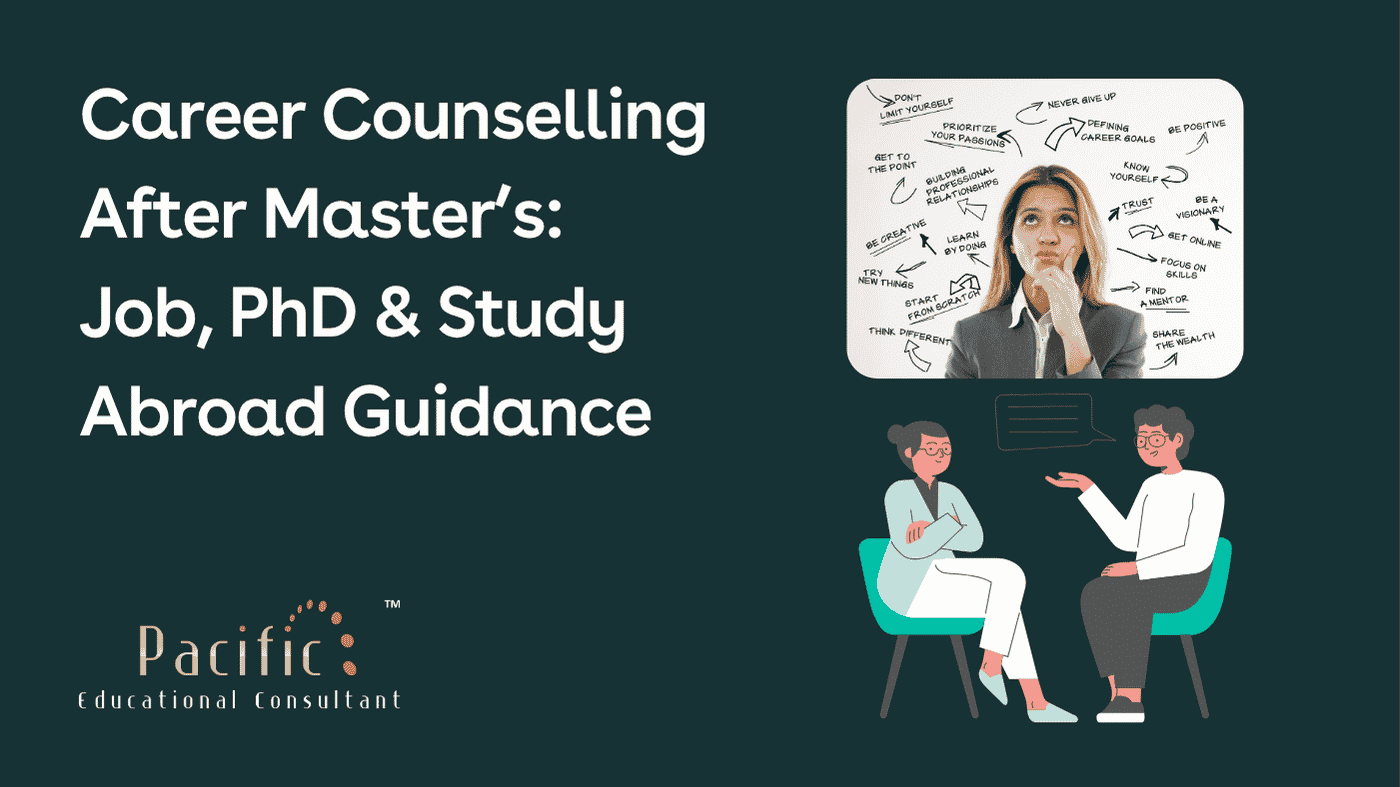
Completing a master’s degree is a big achievement, but many students still feel confused after postgraduation. Some students are not satisfied with job opportunities. Some want to go abroad. Some want to do PhD. Some want to switch careers. Some want to start teaching, business, digital marketing, research or corporate jobs.
This is where career counselling after master’s becomes very important. A professional career counsellor helps postgraduate students understand their next step according to their qualification, skills, experience, interest and long-term career goal.
At Pacific Educational Consultant, Kota, we provide career counselling for students after master’s who want clarity about jobs, PhD, study abroad, career change, professional courses and long-term career growth.
Many students believe that after completing master’s, career confusion should end. But in reality, many students become more confused because they have to make serious career decisions.
Common questions after master’s include:
Should I start a job or study further?
Should I do PhD?
Should I study abroad after master’s?
Can I change my career field?
Which job profile is suitable for me?
Should I prepare for government exams?
Should I become a teacher or trainer?
Which skills should I learn after master’s?
How can I get better salary growth?
Can I move from academic field to corporate field?
Career counselling helps students answer these questions with a proper plan.
Postgraduate students often make mistakes because they feel pressure to start earning quickly or choose any available option.
Common mistakes include:
Applying for random jobs without career direction
Doing PhD without understanding research interest
Ignoring skill development
Choosing another degree without purpose
Not building a strong resume
Not preparing for interviews
Not using LinkedIn properly
Ignoring overseas opportunities
Not understanding industry demand
Preparing for government exams without backup plan
Career counselling helps postgraduate students make a clear and practical decision.
The counsellor first reviews the student’s master’s degree, specialization, academic performance, projects, internships, research work and work experience.
For example:
An MBA student may explore marketing, finance, HR, operations, business analytics, consulting or entrepreneurship.
An MA English student may explore teaching, IELTS training, content writing, publishing, communication training or PhD.
An MSc student may explore research, teaching, lab work, data science, healthcare, biotechnology or overseas education.
An M.Com student may explore accounting, finance, taxation, banking, teaching or professional certifications.
An MCA student may explore software development, data science, cybersecurity, cloud computing or IT management.
The counsellor asks what the student wants in the long term. Some students want salary growth. Some want stability. Some want government jobs. Some want academic careers. Some want international exposure.
Career goals may include:
Corporate job
Teaching career
PhD and research
Government job
Study abroad
Entrepreneurship
Career switch
Freelancing
Professional certification
Skill-based career
After master’s, choosing the right job profile is very important. The counsellor helps students understand which roles match their degree and skills.
For example:
MBA graduates can apply for marketing executive, business development executive, finance analyst, HR executive, operations executive or management trainee roles.
MA English graduates can become English trainers, IELTS trainers, content writers, communication trainers or academic coordinators.
MSc graduates can work in research, teaching, labs, analytics or technical roles depending on specialization.
MCA graduates can work as software developers, system analysts, web developers or data analysts.
A master’s degree alone may not be enough in today’s job market. Employers look for practical skills.
Important skills after master’s include:
Communication skills
Interview skills
Resume writing
LinkedIn profile building
Excel
Data analysis
Digital marketing
Research writing
Public speaking
Presentation skills
Technical tools
Professional email writing
Leadership skills
Career counselling helps students understand which skills they need for their target career.
Many students after master’s are confused between PhD and job. Career counselling helps them compare both.
PhD may be suitable if the student is interested in research, teaching, academic writing and university-level career.
Job may be suitable if the student wants practical experience, income, corporate growth and industry exposure.
The counsellor helps students choose the option that matches their interest and long-term plan.
Some students want to study abroad even after completing master’s. They may choose a second master’s, MBA, research program, PhD or specialized professional course.
Career counselling helps them understand:
Whether a second master’s is logical
Which country is suitable
How to justify academic progression
Which course matches previous education
What are visa requirements
How to prepare SOP
What financial documents are needed
What future career plan should be shown
Study abroad after master’s requires strong justification and proper planning.
Many students want to change their field after master’s. For example, an MA student may want to move into digital marketing. An MBA student may want to move into data analytics. An M.Com student may want to move into business analytics.
Career counselling helps students understand whether the career switch is possible and what skills or certifications are required.
At the end of counselling, the student receives a clear roadmap. This may include:
Suitable job roles
Required skills
Courses or certifications
Study abroad options
PhD planning
Resume improvement
Interview preparation
Timeline for next 6 to 12 months
Long-term career direction
MBA graduates can explore:
Marketing Management
Finance
Human Resources
Operations
Business Analytics
Digital Marketing
Sales Management
Business Development
Consulting
Entrepreneurship
International Business
Product Management
MBA students should choose a specialization-based job role and build practical skills.
MA graduates can explore:
Teaching
Content Writing
IELTS Training
Academic Counselling
Research
PhD
Public Administration
Civil Services
Social Work
Communication Training
Publishing
Journalism
MA students should focus on communication, writing, research and subject expertise.
MSc graduates can explore:
Research
Teaching
PhD
Data Science
Laboratory Work
Biotechnology
Healthcare
Environmental Science
Analytics
Technical Roles
Study Abroad
The right option depends on the MSc specialization.
M.Com graduates can explore:
Accounting
Taxation
Banking
Finance
Teaching
PhD
CA Inter
CMA
ACCA
Financial Analysis
Business Analytics
M.Com students should focus on finance tools, taxation knowledge, Excel and accounting software.
MCA graduates can explore:
Software Development
Web Development
Data Science
Cyber Security
Cloud Computing
Database Administration
System Analyst
IT Project Management
App Development
AI and Machine Learning
MCA students should focus on projects, coding, internships and industry certifications.
Aditya completed MBA but was not satisfied with his job options. He was confused between corporate jobs, digital marketing, entrepreneurship and international opportunities.
During counselling, his management background, communication ability and interest in business growth were assessed. He was guided toward Digital Marketing and Business Development.
His roadmap included SEO, Google Ads, Meta Ads, CRM, sales funnel understanding, LinkedIn profile improvement and interview preparation.
Final career direction: Marketing manager, business development manager, growth executive or digital marketing strategist.
Sana completed MA English and was confused between teaching, content writing, IELTS training and PhD. She had strong language skills but needed practical career direction.
After counselling, she was guided toward IELTS Training, Spoken English Training and Academic Content Writing.
Her roadmap included IELTS module training, grammar teaching skills, public speaking, content writing, classroom management and online teaching skills.
Final career direction: IELTS trainer, spoken English trainer, academic content writer or English lecturer.
Study abroad after master’s is possible, but it requires strong planning. Students must clearly explain why they want to study again and how the new course connects with their previous education and future goal.
Suitable options may include:
Second master’s degree
MBA abroad
PhD
Research-based program
Specialized postgraduate diploma
Professional master’s program
A strong SOP is very important for students applying abroad after master’s because the visa officer or university may ask why the student wants to study again.
Pacific Educational Consultant helps students prepare a proper academic progression plan for overseas education after master’s.
Career switching after master’s is possible if the student builds the right skills. For example:
MBA to Digital Marketing
MA English to IELTS Training
M.Com to Business Analytics
MSc Mathematics to Data Science
MCA to Cyber Security
MA Psychology to Career Counselling
MSc Biology to Public Health
Career counselling helps students understand the correct path for career switching.
Pacific Educational Consultant provides professional career counselling for postgraduate students who want to plan their next step after master’s.
We guide students for:
Job role selection
Career change planning
PhD guidance
Study abroad after master’s
Second master’s planning
Professional courses
Resume building
Interview preparation
IELTS/PTE preparation
SOP and documentation
Visa guidance
Long-term career growth
After master’s, you can choose a job, PhD, study abroad, professional certification, teaching, business, government exam preparation or career switch. The best option depends on your qualification, interest and career goal.
Yes, career counselling after master’s is very useful because many postgraduate students are confused about jobs, PhD, study abroad or career change.
Yes, students can study abroad after master’s for a second master’s, MBA, PhD or specialized professional course. However, the course should be properly justified.
PhD is suitable if you are interested in research, academic writing, teaching and university-level career. If you want corporate growth, job experience may be a better option.
Yes, career change is possible after master’s if you build the required skills and certifications. A career counsellor can help you understand the best transition path.
Important skills after master’s include communication, leadership, resume writing, interview skills, Excel, digital skills, data analysis, research writing, public speaking and professional networking.
After MBA, students can choose marketing, finance, HR, operations, business analytics, digital marketing, sales, consulting, entrepreneurship or international business.
After MA English, students can choose teaching, IELTS training, spoken English training, content writing, editing, publishing, PhD or academic coordination.
Students can visit Pacific Educational Consultant, Kota for expert career counselling after master’s, study abroad guidance, job planning and career roadmap support.
Career counselling after master’s helps students make the right decision for their next step. Whether you want a job, PhD, overseas education, career change or professional growth, proper guidance can save time and help you choose the right path.
A master’s degree is valuable, but the right career strategy makes it more powerful.
Visit Pacific Educational Consultant, Kota for expert guidance on job planning, PhD options, study abroad, career switch and long-term career growth.

Book a Free Counselling

All You Need to Know About Snow Reading Answers
Study Abroad Consultant in Kota | Free Counselling 2026-27
Transition Care for the Elderly IELTS Reading Answers
GRE Accepted Universities in Germany 2027: Scores & Cut-offs
Ireland Education Fair 2026 India Dates, Venues & Universities
PTE Accepted Universities in France 2027-28 Verified List, Scores, Visa Rules & Funds

Welcome to Pacific Educational Consultant and Classes, your trusted partner in unlocking a world of educational opportunities and personal growth.


© 2026 Pacific Educational Consultant. All rights reserved
 Canada
 United States
 United Kingdom
 Australia
 Germany
 France
 Netherlands
 New Zealand
 PTE
PTE
 IELTS General Training
 TOEFL iBT
 Duolingo English Test
 SAT
SAT
 GRE
GRE
 GMAT
GMAT
 SPOKEN ENGLISH
 SOP Writing
 Air Tickets
 Accommodation
 Career Counselling
 Visa Assistance