

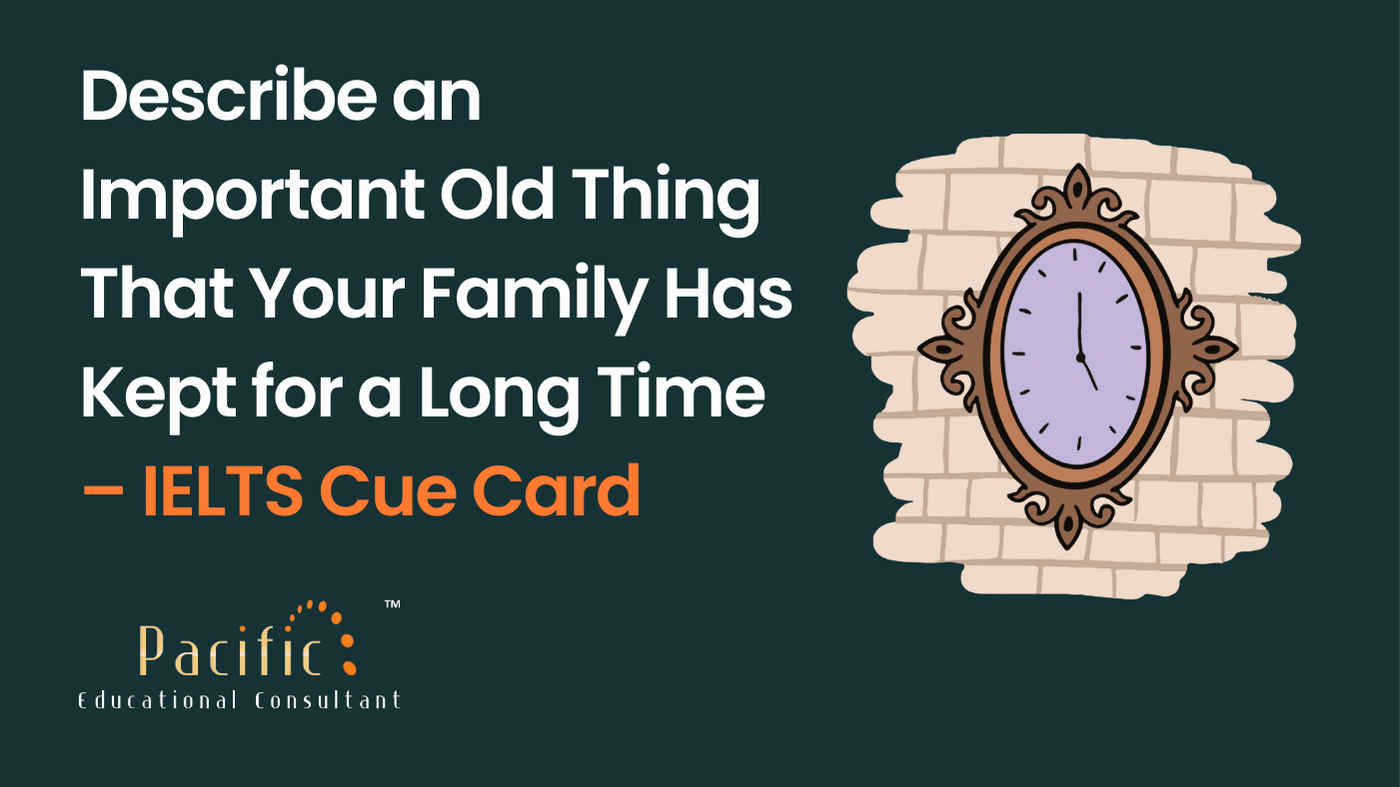
In the IELTS Speaking test, cue card topics about memories and family belongings are very common. One such topic is “Describe an important old thing that your family has kept for a long time.”
This question checks your ability to describe an object, explain its history, and express emotions clearly. In this blog, you will find a high-scoring sample answer and well-structured responses to follow-up questions.
You should say:
What it is
How and when your family first got this thing
How long your family has kept it
And explain why this thing is important to your family
One important old thing that my family has kept for a long time is a wooden wall clock that belonged to my grandfather.
My family first got this clock about 50 years ago when my grandfather purchased it after getting his first government job. It was considered a luxury item at that time and was placed in the main living room of our house.
We have kept this clock for almost three generations now. Even today, it still works perfectly and hangs on the same wall where it used to be during my childhood.
This clock is very important to my family because it reminds us of my grandfather’s hard work and dedication. It also represents family unity, as every family gathering takes place in the same room where the clock hangs. For us, it is not just a timepiece but a symbol of tradition, memories, and emotional value.
People in my country usually like to keep family jewelry, old photographs, religious books, furniture, medals, and ancestral documents. These items are often passed down from one generation to another as family heritage.
People keep old things mainly because of their emotional value and memories. Some items also have historical importance, while others are kept to honor elders or remember special moments in life.
Old people mostly keep items related to family history, religion, and tradition, such as letters or old tools. Young people, on the other hand, prefer to keep digital memories like photos on phones, social media posts, or electronic gadgets.
In the past, people kept physical items like books, furniture, and handwritten letters. Today, people mostly store memories digitally in the form of photos, videos, and cloud storage. Modern items are lighter and easier to preserve.
In a museum, we can see ancient tools, paintings, sculptures, traditional clothes, weapons, coins, and historical documents. Museums display objects that represent culture and history.
From a museum, we can learn about history, culture, scientific progress, and the lifestyle of people in the past. Museums help us understand how civilizations developed and what mistakes or achievements shaped society.
Ancestral property
Family heritage
Emotional attachment
Historical significance
Well-preserved
Symbol of tradition
Describing an old family object is an excellent way to show your storytelling skills in IELTS Speaking. Always talk about its history, emotional value, and importance to your family. Use clear structure and simple but meaningful vocabulary.
Want more IELTS cue card sample answers, vocabulary lists, and speaking strategies?


Book a Free Counselling

Pacific Prime Membership — Study Abroad Support at Effectively ₹0
US Study Visa Interview Questions & Sample Answers

Study Visa Interview for USA: How to Prepare (F-1 2026)

APS Germany Full Guide to the APS Certificate for Indian Students

dMAT Online Course: 2026 Preparation Guide for Germany MS

dMAT Mock Test 2026 Free Sample Papers & Practice PDFs

Welcome to Pacific Educational Consultant and Classes, your trusted partner in unlocking a world of educational opportunities and personal growth.


© 2026 Pacific Educational Consultant. All rights reserved
 Canada
 United States
 United Kingdom
 Australia
 Germany
 France
 Netherlands
 New Zealand
 PTE
PTE
 IELTS General Training
 TOEFL iBT
 Duolingo English Test
 SAT
SAT
 GRE
GRE
 GMAT
GMAT
 SPOKEN ENGLISH
 SOP Writing
 Air Tickets
 Accommodation
 Career Counselling
 Visa Assistance