

You should say:
What it is
When and where you saw it
Why you want to learn more about it
And explain what you want to learn more about it
In the IELTS Speaking test, candidates are often asked to talk about animals, nature, and environmental issues. One common cue card topic is “Describe a wild animal that you want to learn more about.”
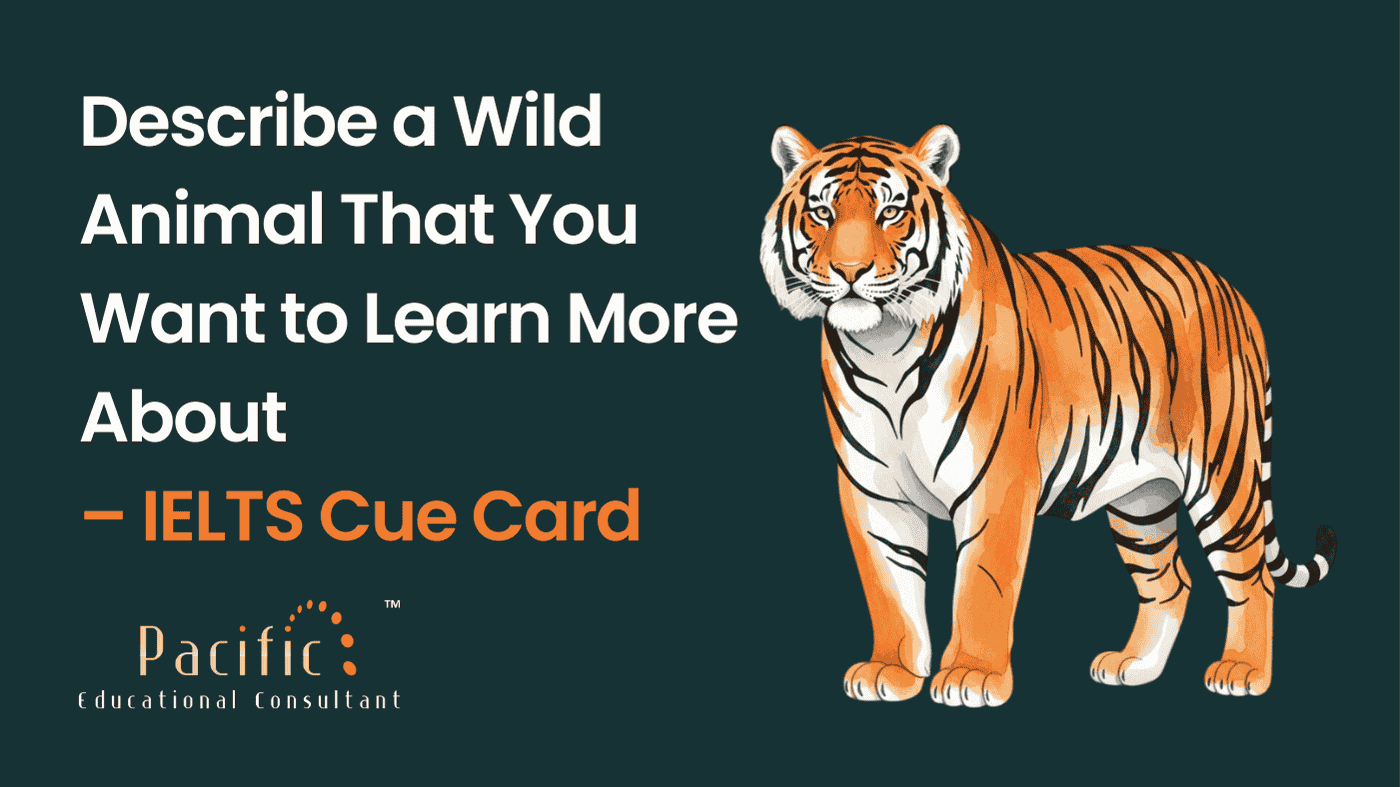
One wild animal that I want to learn more about is the tiger. It is one of the most powerful and majestic animals found mainly in forests and wildlife reserves.
I first saw a tiger in a documentary on National Geographic when I was in school. Later, I also saw one during a visit to Ranthambore National Park in Rajasthan. Watching it move silently and confidently through the forest was truly unforgettable.
I want to learn more about tigers because they are endangered animals and play a very important role in maintaining the balance of nature. Sadly, their population is decreasing due to poaching and habitat destruction.
I would like to learn more about their hunting habits, communication methods, and how they survive in the wild. I am also curious to know how conservation programs protect them and what common people can do to save them from extinction. Understanding these things will help me become more responsible toward wildlife protection.
We should protect wild animals because they are an essential part of the ecosystem. They help maintain food chains and natural balance. If wild animals disappear, it can disturb the environment and lead to serious ecological problems.
Some people are more willing to protect wild animals because they are aware of environmental issues and feel emotionally connected to nature. Others may not care because they do not directly see the impact of wildlife loss in their daily lives.
Yes, it is important because children can learn about animals in a practical way. Zoos help children understand animal behavior and develop respect for wildlife. However, zoos should ensure animals are kept in healthy and safe conditions.
Rare animals are close to extinction, so protecting them becomes urgent. Once a species disappears, it can never return. Therefore, people focus more on saving rare animals to preserve biodiversity.
Yes, absolutely. Teaching children about wildlife protection from a young age helps create responsible citizens. Schools and parents should encourage activities like tree planting, nature visits, and environmental awareness programs.
Both are equally important because they are connected. Protecting the environment means protecting animals’ homes, and protecting animals helps keep the environment balanced. One cannot survive without the other.
Endangered species – animals at risk of extinction
Habitat destruction – damage to animals’ natural homes
Biodiversity – variety of life on Earth
Ecosystem balance – natural stability of nature
Wildlife conservation – protection of animals and forests
This cue card topic allows you to show your vocabulary, reasoning skills, and concern for nature. Practice speaking clearly and naturally while adding examples and reasons to score a higher band in IELTS Speaking.

📞 Call Now: +91 9983256783 | 8302793737 | 7627038050

Book a Free Counselling

Pacific Prime Membership — Study Abroad Support at Effectively ₹0

US Study Visa Interview Questions & Sample Answers

Study Visa Interview for USA: How to Prepare (F-1 2026)

APS Germany Full Guide to the APS Certificate for Indian Students

dMAT Online Course: 2026 Preparation Guide for Germany MS

dMAT Mock Test 2026 Free Sample Papers & Practice PDFs

Welcome to Pacific Educational Consultant and Classes, your trusted partner in unlocking a world of educational opportunities and personal growth.


© 2026 Pacific Educational Consultant. All rights reserved
 Canada
 United States
 United Kingdom
 Australia
 Germany
 France
 Netherlands
 New Zealand
 PTE
PTE
 IELTS General Training
 TOEFL iBT
 Duolingo English Test
 SAT
SAT
 GRE
GRE
 GMAT
GMAT
 SPOKEN ENGLISH
 SOP Writing
 Air Tickets
 Accommodation
 Career Counselling
 Visa Assistance