

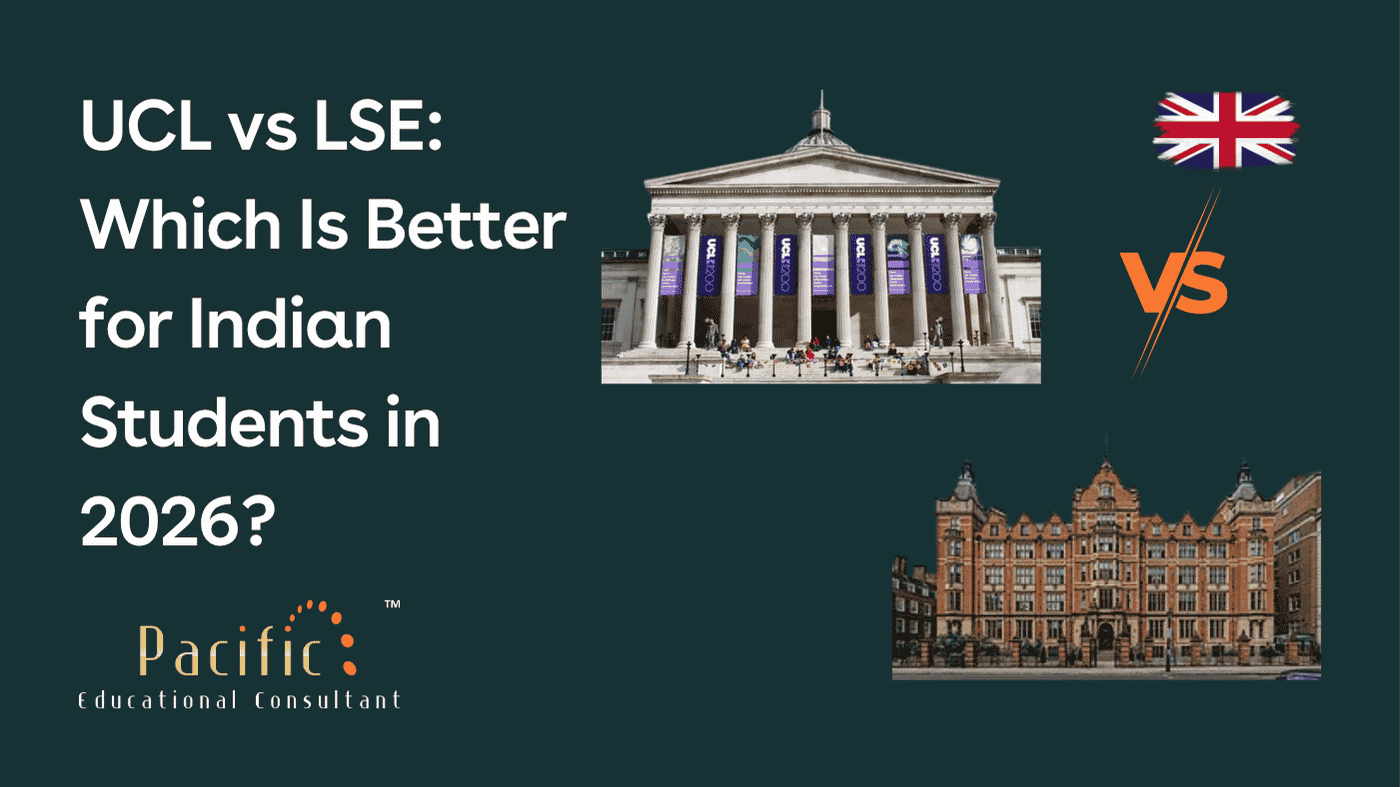
Choosing between UCL vs LSE is one of the biggest decisions for Indian students planning to study in London. Both universities are globally respected, both are located in central London, and both are part of the prestigious Russell Group. But they are not the same.
UCL is a large, multidisciplinary research university with strong options in engineering, medicine, architecture, data science, education, psychology, law and social sciences. LSE, on the other hand, is a specialist university known worldwide for economics, finance, politics, law, management, public policy and social sciences.
So, the real question is not simply “Is UCL better than LSE?” The better question is:
Which university is better for your course, career goal, budget and admission profile?
This complete guide compares UCL vs LSE ranking, fees, acceptance rate, courses, student life, career opportunities and Indian student eligibility for the 2026 intake.
| Factor | UCL | LSE |
| Best for | Broad subject options, STEM, medicine, architecture, education, research | Economics, finance, politics, law, management, public policy |
| QS World Ranking 2027 | 8th | 62nd |
| University type | Large multidisciplinary university | Specialist social science university |
| Founded | 1826 | 1895 |
| Location | Central London | Central London |
| Total students | Around 51,800 | Around 12,000 |
| International students | Around 53% | 70%+ |
| Undergraduate courses | 400+ | Around 40 |
| Best choice for Indian students | Wider course choice and relatively more achievable admission | Strongest for economics, finance, policy and social sciences |
The QS World University Rankings 2027 were released in June 2026 and assess universities using indicators such as academic reputation, employer reputation, research impact, international outlook, sustainability and graduate employability.
In the QS World University Rankings 2027, UCL ranks much higher overall than LSE. This can make many Indian students and parents feel that UCL is automatically better.
But that is not always true.
UCL performs strongly in overall rankings because it is a large university with many departments, including medicine, engineering, sciences, architecture, education, law, humanities and social sciences. Large research universities often perform better in overall global rankings because they produce research across many fields.
LSE is smaller and more focused. It does not offer medicine, engineering or broad STEM options. Its strength is concentrated in economics, politics, finance, management, law, international relations and social sciences.
That is why students should compare subject ranking, not only overall ranking.
Simple rule:
For engineering, medicine, architecture, education, psychology, data science and broad research options, UCL is usually stronger.
For economics, finance, politics, international relations, public policy and management, LSE often has a stronger subject reputation.
Your course choice should be the biggest deciding factor in the UCL vs LSE comparison.
UCL offers hundreds of undergraduate and postgraduate programs, which makes it a better choice for students who want wider academic flexibility.
LSE is ideal for students who are very clear about building a career in finance, consulting, economics, policy, government, international organisations or social sciences.
Counsellor Insight: Many Indian students compare UCL and LSE without checking whether LSE even offers their desired course. LSE does not offer engineering, medicine or traditional STEM degrees. So before applying, always check the exact course availability.
Both universities are expensive for Indian students because they are located in London and charge international tuition fees.
Approximate annual tuition fee range:
| Program Level | UCL | LSE |
| Undergraduate | £26,200–£47,000 | £27,500–£34,000 |
| Postgraduate taught | £26,200–£57,000 | Around £28,000–£48,500 |
Using an approximate exchange rate of ₹125 per GBP, Indian students should budget:
London is one of the most expensive student cities in the world. Indian students should keep a separate budget for:
A safe living cost estimate for London is around ₹21 lakh to ₹28 lakh per year, depending on lifestyle and accommodation.
Counsellor Insight: Do not calculate only tuition fees. For London, the complete budget should include tuition fee + living cost + visa fee + IHS + travel + emergency funds.
LSE is generally harder to get into than UCL, especially for competitive courses like Economics, Finance, Management, Law and International Relations.
UCL is also highly selective, but because it is much larger and offers more courses, Indian students may find more realistic options at UCL compared to LSE.
Recent admission data shows UCL receiving very high application numbers, with an overall offer rate of around 44.2% in 2025. LSE remains highly competitive, especially because of its smaller size and specialist course structure.
For undergraduate courses, students usually need strong Class 12 results. Competitive courses may require very high percentages, often 90% or above.
For postgraduate courses, students usually need:
LSE accepts India’s three-year bachelor’s degree for many postgraduate programs, but admission remains very competitive. UCL requirements can vary by department, so students with a three-year Indian bachelor’s degree should check the exact course page before applying.
For postgraduate applications, Indian students should usually prepare:
| Document | Details |
| Degree certificate / provisional certificate | Accepted if final degree is pending |
| Semester marksheets | All semester marksheets required |
| Statement of Purpose | Course-specific SOP, not a generic essay |
| Letters of Recommendation | Usually 2 academic or professional LORs |
| Passport | Must be valid for the course duration |
| English test score | IELTS / TOEFL / PTE as per university requirement |
| CV | Required for many master’s courses |
| Work experience proof | Important for management, finance and policy courses |
| Portfolio | Required for design, architecture or creative courses |
| CAS | Issued after offer acceptance and fee deposit |
Both universities mainly follow the September intake for international students. Indian students should start early because top courses can close quickly.
| Indian Academic Month | What to Do |
| April–June | Shortlist courses, check eligibility, start IELTS preparation |
| July–September | Take IELTS/PTE, prepare SOP, collect LORs |
| October–December | Apply for postgraduate courses early; UG students apply via UCAS |
| January | UCAS equal consideration deadline for undergraduate courses |
| January–March | Receive offers, compare fees, scholarships and career outcomes |
| April–June | Accept offer, pay deposit, arrange funds |
| June–August | Receive CAS, apply for UK Student Visa |
| September | Course begins |
Counsellor Insight: For LSE and competitive UCL courses, early application is very important. Waiting until March or April can reduce your chances because popular courses may already be full.
Both universities offer excellent career opportunities, but the career direction is different.
UCL is strong for students targeting:
UCL’s large alumni network and broad employer connections make it useful for students who want flexibility across industries.
LSE is especially strong for students targeting:
LSE has one of the strongest reputations in the world for economics, finance, politics and social sciences. For students aiming for banking, consulting or policy careers, the LSE brand can be extremely powerful.
Counsellor Insight: If your target is investment banking, economics, public policy or international relations, LSE usually has stronger career positioning. If your target is technology, healthcare, architecture, research, education or interdisciplinary careers, UCL may be a better option.
Both universities are located in London, but the student experience is different.
UCL has a larger campus feel, more departments, a wider student community and a broader range of societies. Students from different academic backgrounds study together, which creates a more diverse university environment.
UCL is better for students who want:
LSE has a smaller and more focused environment. Most students are interested in social sciences, economics, politics, finance, management and policy. The academic atmosphere can feel more intense and career-driven.
LSE is better for students who want:
Both UCL and LSE are excellent for law. However, the best choice depends on your career goal.
Choose UCL Law if you want a broader legal education, strong research environment and a large university ecosystem.
Choose LSE Law if you are interested in law with economics, policy, regulation, finance, governance or international institutions.
For Indian students planning legal careers in corporate law, policy, international law or regulation, both are strong. LSE may feel more suitable for students who want law connected with economics and public policy.
For economics and finance, LSE usually has the stronger specialist reputation.
LSE is globally known for:
UCL also offers strong economics and finance-related courses, but LSE has a more direct connection with finance, consulting, policy and economic research careers.
Best choice for Economics: LSE
Best choice for Finance: LSE
Best choice for Economics + wider academic flexibility: UCL
Best choice for Finance + London banking route: LSE
For master’s students, the decision should be based on course and career outcome.
Choose UCL for master’s if your field is:
Choose LSE for master’s if your field is:
For Indian students, LSE master’s courses can be highly competitive and expensive, but they may offer strong return on investment for finance, consulting and policy careers.
There is no single answer. The best university depends on the student profile.
If we compare only overall ranking, UCL looks stronger. But if we compare social sciences, economics, finance, policy and management, LSE can be the better choice.
For Indian students, the right decision should be based on:
Final recommendation:
Choose UCL for broader academic options, STEM, research, architecture, education and multidisciplinary study.
Choose LSE for economics, finance, management, politics, law, policy and social science careers.
UCL is better in overall global ranking and offers a wider range of courses. However, LSE is stronger for economics, finance, politics, public policy, management and social sciences.
Yes, LSE is generally harder to get into because it is smaller, more specialised and highly competitive, especially for economics, finance, law and management courses.
UCL is better for students who want wider course options and STEM-related fields. LSE is better for students targeting economics, finance, policy, politics, management and consulting careers.
LSE is usually considered stronger for economics because of its specialist reputation and strong connection with finance, policy and economic research careers.
Both are excellent for law. UCL offers a broader legal education, while LSE is strong for law connected with economics, policy, governance and regulation.
LSE is more prestigious in economics, finance, politics and social sciences. UCL is more prestigious in overall global ranking, research breadth, architecture, education, medicine and multidisciplinary subjects.
Indian students should expect around ₹33 lakh to ₹72 lakh per year for tuition, depending on the university and course. London living cost can add around ₹21 lakh to ₹28 lakh per year.
Yes, both universities accept Indian students for undergraduate and postgraduate courses. Students must meet academic, English language and course-specific requirements.
LSE accepts a three-year Indian bachelor’s degree for many master’s courses. UCL requirements vary by department, so students should check the exact course page before applying.
Both offer excellent career opportunities. LSE is stronger for banking, consulting, economics and policy. UCL is stronger for research, technology, healthcare, architecture, education and broader career options.
At Pacific Educational Consultant, we help Indian students shortlist the right UK university based on course, eligibility, budget, career goal and visa success strategy.


Book a Free Counselling

Pacific Prime Membership — Study Abroad Support at Effectively ₹0

US Study Visa Interview Questions & Sample Answers

Study Visa Interview for USA: How to Prepare (F-1 2026)

APS Germany Full Guide to the APS Certificate for Indian Students

dMAT Online Course: 2026 Preparation Guide for Germany MS

dMAT Mock Test 2026 Free Sample Papers & Practice PDFs

Welcome to Pacific Educational Consultant and Classes, your trusted partner in unlocking a world of educational opportunities and personal growth.


© 2026 Pacific Educational Consultant. All rights reserved
 Canada
 United States
 United Kingdom
 Australia
 Germany
 France
 Netherlands
 New Zealand
 PTE
PTE
 IELTS General Training
 TOEFL iBT
 Duolingo English Test
 SAT
SAT
 GRE
GRE
 GMAT
GMAT
 SPOKEN ENGLISH
 SOP Writing
 Air Tickets
 Accommodation
 Career Counselling
 Visa Assistance