

Money management is an important life skill, yet sometimes we end up spending more than we plan—especially on items we really want or need. In the IELTS Speaking test, cue cards like “Describe an item on which you spent more than expected” help examiners assess your ability to describe experiences clearly, use past tense correctly, and explain reasons logically.
In this blog, you’ll find a model cue card answer, follow-up question answers, and useful vocabulary to score higher in IELTS Speaking.
You should say:
What it is
How much you spent on it
Why you bought it
And explain why you think you spent more than expected
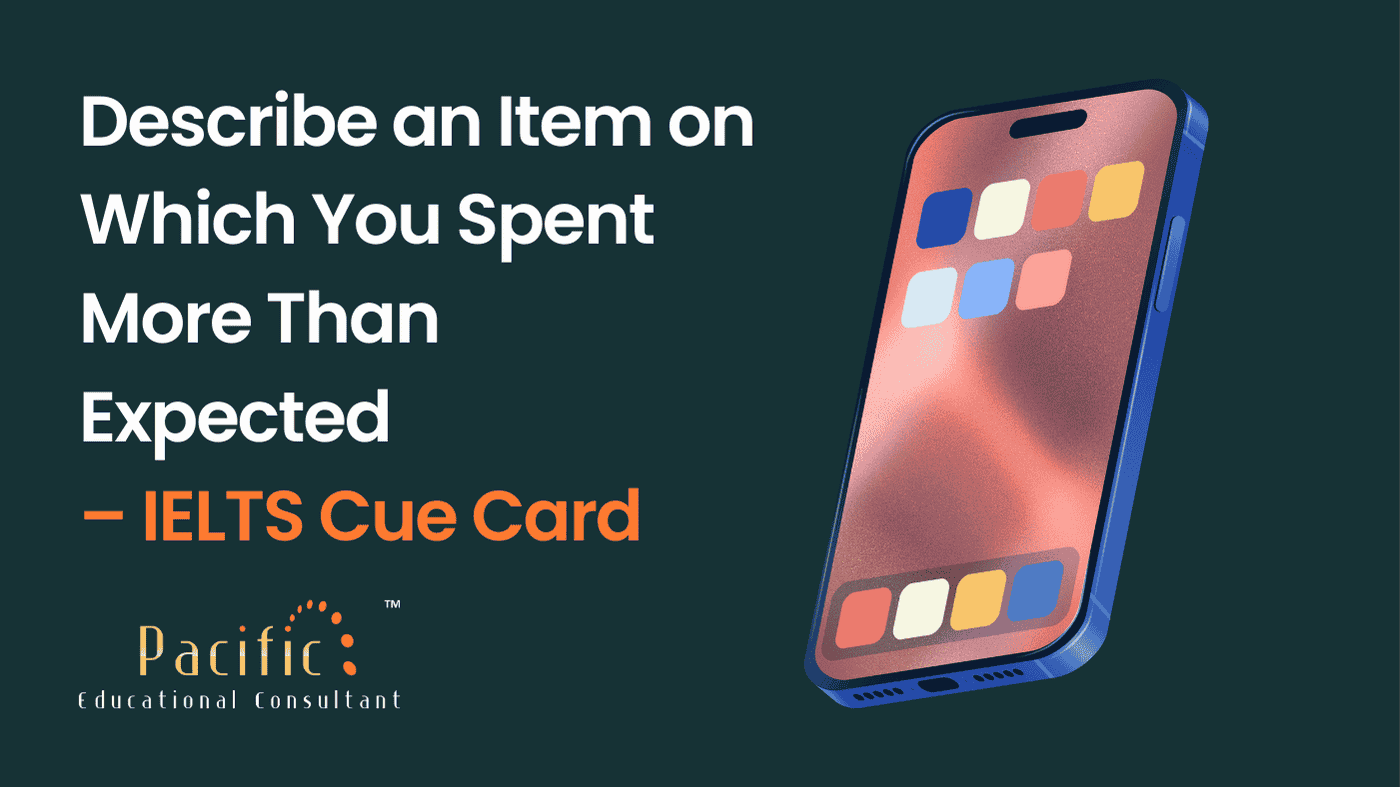
One item on which I spent more than expected was a smartphone that I bought last year.
I had planned to buy a mid-range phone costing around ₹20,000. However, when I visited the store, the salesperson showed me a newly launched model with better camera quality, higher storage, and advanced security features. Eventually, I ended up spending nearly ₹38,000, which was much more than my original budget.
I bought this phone because my old one had become very slow and its battery drained quickly. Since I use my phone daily for online classes, payments, and communication, I wanted something reliable and long-lasting.
I think I spent more than expected mainly because I was influenced by attractive offers and the features I hadn’t planned for. The salesperson also convinced me that investing more money would give me better value in the long run. Although I felt a little guilty at first, later I realized that the phone’s performance justified the extra cost.
Not very often, but it happens occasionally, especially when I go shopping without proper planning. Discounts and attractive displays sometimes tempt me to spend more than my budget. However, I try to control myself by making a list before shopping.
I believe young people spend most of their money on gadgets, clothes, food, and entertainment such as movies and online subscriptions. Nowadays, many also invest in mobile phones, headphones, and fashionable items to maintain a modern lifestyle.
Yes, saving money is extremely important because it provides financial security in emergencies. It also helps people achieve long-term goals like higher education, buying a house, or starting a business. Moreover, saving teaches discipline and responsible spending habits.
Yes, many people buy unnecessary items due to advertisements, peer pressure, or emotional reasons. Online shopping makes this problem even worse because everything is just one click away. As a result, people often purchase things they rarely use.
Exceeded my budget
Impulse buying
Worth the price
Financial discipline
Long-term investment
Tempting offers
Use past tense clearly (I bought, I spent, I realized).
Add reasons and examples to extend your answer.
Avoid short responses; aim for 1–2 minutes for cue cards.
Use linking words: because, however, therefore, eventually.
Join our expert-led IELTS preparation program with daily cue card practice, mock tests, and personalized feedback.

Book a Free Counselling
Pacific Prime Membership — Study Abroad Support at Effectively ₹0
US Study Visa Interview Questions & Sample Answers
Study Visa Interview for USA: How to Prepare (F-1 2026)
APS Germany Full Guide to the APS Certificate for Indian Students

dMAT Online Course: 2026 Preparation Guide for Germany MS

dMAT Mock Test 2026 Free Sample Papers & Practice PDFs

Welcome to Pacific Educational Consultant and Classes, your trusted partner in unlocking a world of educational opportunities and personal growth.


© 2026 Pacific Educational Consultant. All rights reserved
 Canada
 United States
 United Kingdom
 Australia
 Germany
 France
 Netherlands
 New Zealand
 PTE
PTE
 IELTS General Training
 TOEFL iBT
 Duolingo English Test
 SAT
SAT
 GRE
GRE
 GMAT
GMAT
 SPOKEN ENGLISH
 SOP Writing
 Air Tickets
 Accommodation
 Career Counselling
 Visa Assistance