

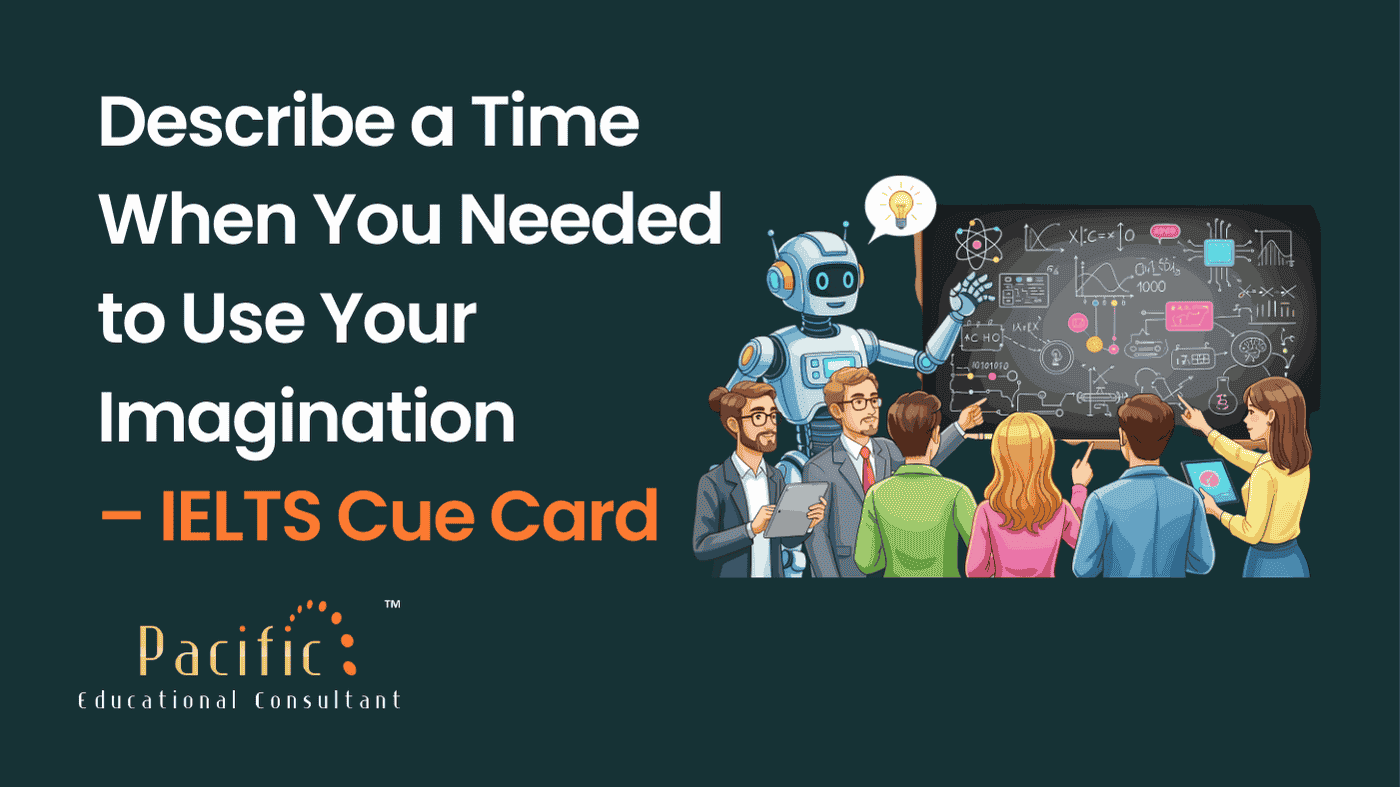
Imagination plays an important role in our daily life. It helps us solve problems creatively, express our thoughts clearly, and think beyond ordinary situations. In the IELTS Speaking test, candidates are often asked to describe personal experiences where imagination was required. One such cue card is “Describe a time when you needed to use your imagination.”
In this blog, you will find a complete model answer along with follow-up questions to help you score a higher band in IELTS Speaking.
You should say:
When it was
When you needed to use imagination
How difficult or easy it was
And explain how you felt about it
One time when I really needed to use my imagination was during my college presentation last year. Our teacher asked us to prepare a presentation on “Future Technology in Education,” but instead of using only facts, we were told to create a creative concept and present it as if it already existed.
I had to imagine how classrooms would look in the future — with AI teachers, virtual reality lessons, and smart boards that respond to voice commands. I created a fictional classroom scenario and described how students would attend classes using holograms and VR headsets.
At first, it was a little challenging because I am more used to working with real data and practical examples. However, once I started visualising the future classroom, ideas started flowing naturally, and the task became quite enjoyable.
I felt very excited and proud of myself after completing the presentation. It boosted my confidence and made me realise that imagination is a powerful skill, especially when combined with knowledge.
Yes, absolutely. Many adults have a strong imagination, especially those working in creative fields such as design, marketing, writing, and filmmaking. Even entrepreneurs and business leaders use imagination to develop innovative ideas and future strategies. Imagination is not limited to children; it grows with experience.
Yes, imagination is extremely important for scientists. Many scientific discoveries begin with imagination. Scientists imagine new possibilities, theories, and experiments before testing them in real life. Without imagination, innovation and invention would not be possible.
Jobs in creative fields require a high level of imagination. For example, artists, architects, writers, graphic designers, advertisers, filmmakers, and game developers all depend on imagination. Apart from that, even teachers and engineers use imagination to explain complex ideas and design better solutions.
Subjects like art, literature, history, drama, and creative writing are very helpful for developing imagination. Even science fiction, geography, and social studies encourage students to think beyond reality and explore new ideas. These subjects help build creative thinking and problem-solving skills.
✔ Use personal experiences
✔ Speak confidently and naturally
✔ Avoid memorised answers
✔ Use examples and emotions
✔ Maintain fluency and clarity
Imagination is a valuable skill that helps us grow personally and professionally. Whether it is for solving problems, creating ideas, or expressing ourselves, imagination plays a crucial role in shaping our thinking. By preparing such cue cards with real-life examples, you can perform confidently in your IELTS Speaking test.
Follow Pacific Educational Consultant – Kota’s Most Trusted IELTS Training Institute

Book a Free Counselling

Pacific Prime Membership — Study Abroad Support at Effectively ₹0
US Study Visa Interview Questions & Sample Answers
Study Visa Interview for USA: How to Prepare (F-1 2026)
APS Germany Full Guide to the APS Certificate for Indian Students

dMAT Online Course: 2026 Preparation Guide for Germany MS

dMAT Mock Test 2026 Free Sample Papers & Practice PDFs

Welcome to Pacific Educational Consultant and Classes, your trusted partner in unlocking a world of educational opportunities and personal growth.


© 2026 Pacific Educational Consultant. All rights reserved
 Canada
 United States
 United Kingdom
 Australia
 Germany
 France
 Netherlands
 New Zealand
 PTE
PTE
 IELTS General Training
 TOEFL iBT
 Duolingo English Test
 SAT
SAT
 GRE
GRE
 GMAT
GMAT
 SPOKEN ENGLISH
 SOP Writing
 Air Tickets
 Accommodation
 Career Counselling
 Visa Assistance