

The IELTS Reading section tests your ability to understand written texts, identify key information, follow the writer’s ideas, and answer different types of questions accurately. In this section, you will answer 40 questions based on three reading passages within 60 minutes.
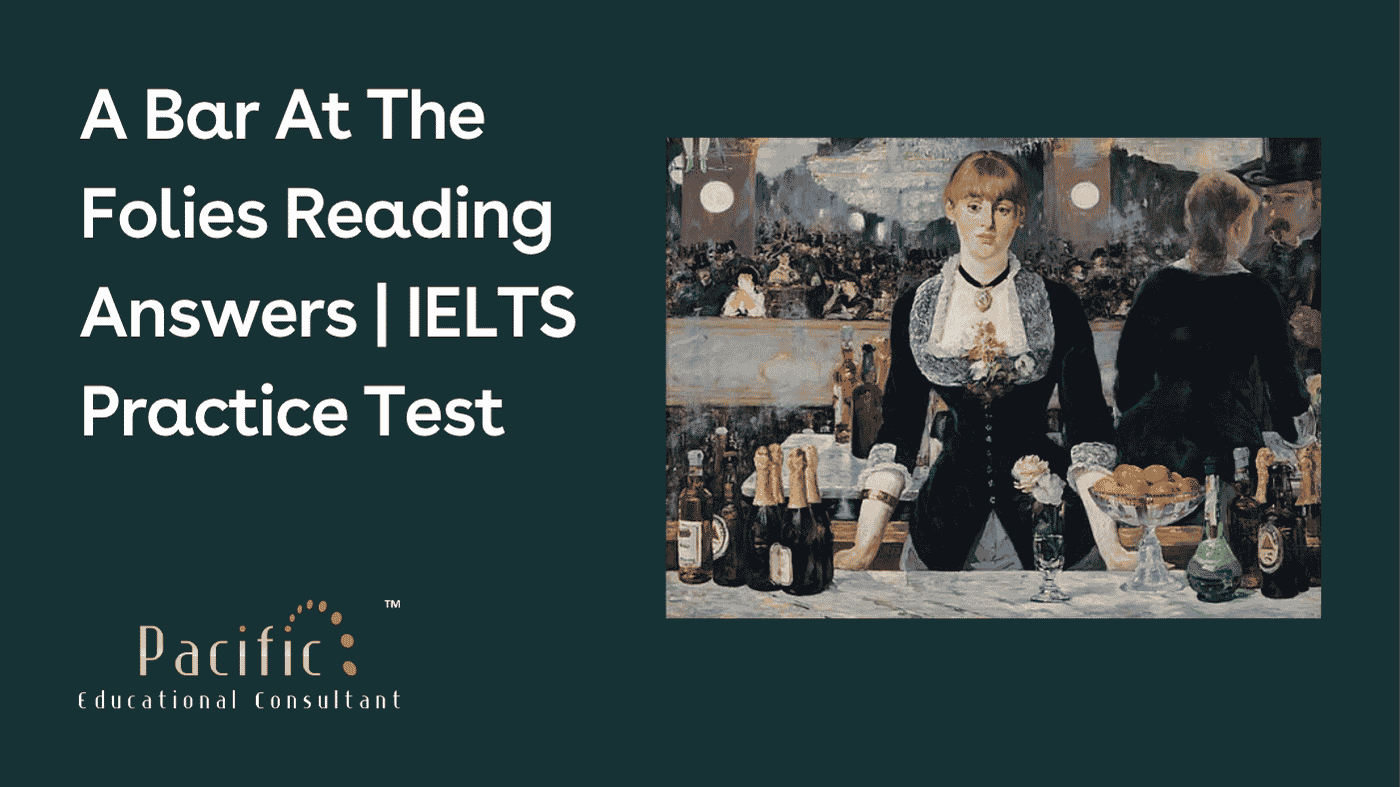
The passage “A Bar At The Folies” is based on Édouard Manet’s famous painting A Bar at the Folies-Bergère, completed in 1882. The painting shows a barmaid standing behind a bar in a busy Parisian entertainment venue. Through the use of a mirror, Manet creates a scene that raises questions about reality, illusion, workplace identity, and modern urban life.
In this IELTS Reading practice test, you will find the full passage, sample questions, answers, and detailed explanations to help you improve your reading skills.
| Question No. | Answer | Question No. | Answer |
| 1 | C | 8 | Auditorium |
| 2 | F | 9 | Trapeze artist |
| 3 | E | 10 | Private studio |
| 4 | D | 11 | E |
| 5 | A | 12 | D |
| 6 | Composer Emmanuel Chabrier | 13 | A |
| 7 | Black bodice | - | - |
Before attempting the passage, keep these IELTS Reading tips in mind:
One of the most critically renowned paintings of the 19th-century modernist movement is the French painter Édouard Manet’s masterwork, A Bar at the Folies. Originally belonging to the composer Emmanuel Chabrier, it is now in the possession of The Courtauld Gallery in London, where it has also become a favourite with the crowds.
The painting is set late at night in a nineteenth-century Parisian nightclub. A barmaid stands alone behind her bar, fitted out in a black bodice that has a frilly white neckline, and with a spray of flowers sitting across her décolletage. She rests her hands on the bar and gazes out forlornly at a point just below the viewer, not quite making eye contact. Also on the bar are some bottles of liquor and a bowl of oranges, but much of the activity in the room takes place in the reflection of a mirror behind the barmaid. Through this mirror, we see an auditorium bustling with blurred figures and faces: men in top hats, a woman examining the scene below her through binoculars, another in long gloves, even the feet of a trapeze artist demonstrating acrobatic feats above his adoring crowd. In the foreground of the reflection, a man with a thick moustache is talking with the barmaid.
Although the Folies-Bergère was an actual establishment in late nineteenth-century Paris, and the subject of the painting was a real barmaid who worked there, Manet did not attempt to recapture every detail of the bar in his rendition. The painting was largely completed in a private studio belonging to the painter, where the barmaid posed with a number of bottles, and this was then integrated with quick sketches the artist made at the Folies itself.
Even more confounding than Manet’s relaxed attention to detail, however, is the relationship in the painting between the activity in the mirrored reflection and that which we see in the unreflected foreground. In a similar vein to Diego Velázquez’s much earlier work, Las Meninas, Manet uses the mirror to toy with our ideas about which details are true to life and which are not. In the foreground, for example, the barmaid is positioned upright, her face betraying an expression of lonely detachment, yet in the mirrored reflection, she appears to be leaning forward and to the side, apparently engaging in conversation with her moustachioed customer. As a result of this, the customer’s stance is also altered. In the mirror, he should be blocked from view as a result of where the barmaid is standing, yet Manet has repositioned him to the side. The overall impact on the viewer is one of a dreamlike disjuncture between reality and illusion.
Why would Manet engage in such deceit? Perhaps for that very reason: to depict two different states of mind or emotion. Manet seems to be conveying his understanding of the modern workplace, a place — from his perspective — of alienation, where workers felt torn from their “true” selves and forced to assume an artificial working identity. What we see in the mirrored reflection is the barmaid’s working self, busy serving a customer. The front-on view, however, bears witness to how the barmaid truly feels at work: hopeless, adrift, and alone.
Ever since its debut at the Paris Salon of 1882, art historians have produced reams of books and journal articles disputing the positioning of the barmaid and patron in A Bar at the Folies. Some have even conducted staged representations of the painting in order to ascertain whether Manet’s seemingly distorted point of view might have been possible after all. Yet, while academics are understandably drawn to the compositional enigma of the painting, the layperson is always likely to see the much simpler, more human story beneath. No doubt this is the way Manet would have wanted it.
Have you read the passage carefully? Now try the questions below before checking the answers and explanations.
The reading passage has six paragraphs, A–F.
Which paragraph contains the following information?
Write the correct letter, A–F, in boxes 1–5 on your answer sheet.
In this question type, you need to match each statement with the correct paragraph. The answer is not always written in the same words, so you should look for similar meanings and ideas.
Reference: Paragraph C says that the painting was largely completed in Manet’s private studio, where the barmaid posed with bottles, and this was combined with quick sketches made at the Folies.
Explanation: This paragraph clearly explains Manet’s working process. It tells us that he did not paint the whole scene directly at the nightclub but created the work by combining studio work with sketches from the real location. Therefore, the correct answer is C.
Reference: Paragraph F mentions that art historians have written many books and articles about the positioning of the barmaid and the patron.
Explanation: This paragraph focuses on what academics and art historians have studied most closely. They are especially interested in the composition and the unusual placement of the figures in the painting. Therefore, the correct answer is F.
Reference: Paragraph E explains that Manet may have wanted to show two different emotional states of the barmaid: her working identity and her true inner feelings.
Explanation: This paragraph presents the writer’s interpretation of Manet’s message. It suggests that the painting reflects alienation in the modern workplace and the difference between a worker’s public role and private emotions. Therefore, the correct answer is E.
Reference: Paragraph D explains that the barmaid appears upright in the foreground but seems to be leaning forward in the mirror. It also says that the customer should have been blocked from view, but Manet repositioned him.
Explanation: This paragraph gives examples of the visual contradictions in the painting. These details make the scene appear unrealistic and create confusion between reality and reflection. Therefore, the correct answer is D.
Reference: Paragraph A says that the painting is now in The Courtauld Gallery in London, where it has become a favourite with the crowds.
Explanation: This paragraph directly mentions the popularity of the painting among visitors. The phrase “favourite with the crowds” shows that people enjoy and appreciate the painting. Therefore, the correct answer is A.
Answer the questions below.
Choose NO MORE THAN THREE WORDS from the passage for each answer.
Write your answers in boxes 6–10 on your answer sheet.
In short answer questions, you must find specific information from the passage and write the answer using the word limit given in the instructions.
Reference: Paragraph A states that the painting originally belonged to the composer Emmanuel Chabrier.
Explanation: The word “originally” shows the first ownership of the painting. Since the question asks who the first owner was, the correct answer is Composer Emmanuel Chabrier.
Reference: Paragraph B says that the barmaid is “fitted out in a black bodice that has a frilly white neckline.”
Explanation: The question asks what the barmaid is wearing. The passage clearly mentions her clothing as a black bodice. Therefore, the correct answer is Black bodice.
Reference: Paragraph B says that through the mirror, we see an auditorium filled with blurred figures and faces.
Explanation: The mirror behind the barmaid shows the room behind her. This room is described as an auditorium. Therefore, the correct answer is Auditorium.
Reference: Paragraph B mentions “the feet of a trapeze artist demonstrating acrobatic feats above his adoring crowd.”
Explanation: The question asks who is performing for the audience. The passage clearly says that a trapeze artist is performing. Therefore, the correct answer is Trapeze artist.
Reference: Paragraph C states that the painting was largely completed in a private studio belonging to the painter.
Explanation: The phrase “largely completed” shows where most of the work was done. Since the answer must be no more than three words, the correct answer is Private studio.
Complete each sentence with the correct ending, A–F, below.
Write the correct letter, A–F, in boxes 11–13 on your answer sheet.
A. wanted to find out if the painting’s perspective was realistic
B. felt they had to work very hard at boring and difficult jobs
C. wanted to understand the lives of ordinary people at the time
D. felt like they had to become different people
E. wanted to manipulate our sense of reality
F. wanted to focus on the detail in the painting
In this question type, you need to complete incomplete sentences by choosing the correct ending from a list of options.
Reference: Paragraph D says that Manet uses the mirror to play with ideas of what is true to life and what is not. It also describes a “dreamlike disjuncture between reality and illusion.”
Explanation: Manet’s unusual use of the mirror creates confusion between what is real and what is reflected. This shows that he wanted to affect the viewer’s sense of reality. Therefore, the correct answer is E.
Reference: Paragraph E states that workers felt torn from their “true” selves and were forced to assume an artificial working identity.
Explanation: The paragraph explains that Manet saw the modern workplace as a place of alienation. Workers had to behave differently at work and hide their real emotions. This means they felt like they had to become different people. Therefore, the correct answer is D.
Reference: Paragraph F says that some academics conducted staged representations of the painting to find out whether Manet’s distorted point of view might have been possible.
Explanation: Academics reconstructed the painting to test whether the strange positioning of the figures could exist in reality. Therefore, the correct answer is A.
The passage “A Bar At The Folies” is useful for IELTS Reading practice because it includes art-related vocabulary, descriptive language, and opinion-based interpretation. To answer such passages correctly, students should focus on both factual details and implied meanings.
For example, Paragraph B gives visual details about the painting, while Paragraph E explains the deeper meaning behind Manet’s artistic choices. This means you should not only search for direct answers but also understand the writer’s viewpoint.
When solving IELTS Reading passages based on art, history, or culture, remember these tips:
The A Bar At The Folies Reading Answers passage helps IELTS learners practise important question types such as matching information, short answer questions, and matching sentence endings. The passage also improves your ability to understand descriptive writing, historical references, and deeper meanings in a text.
To perform well in IELTS Reading, practise regularly, learn to identify keywords, and develop the habit of reading for both detail and overall meaning. With consistent practice, you can improve your reading speed, accuracy, and confidence for the IELTS exam.
The passage is about Édouard Manet’s painting A Bar at the Folies-Bergère. It describes the painting, its setting, the use of mirror reflection, and the deeper message about modern work and emotional alienation.
This practice test includes matching information, short answer questions, and matching sentence endings.
The mirror creates a confusing relationship between reality and reflection. It helps Manet show the difference between the barmaid’s public working identity and her private emotional state.
The painting originally belonged to the composer Emmanuel Chabrier.
The painting is currently in The Courtauld Gallery in London.
This passage helps students practise scanning for details, understanding paragraph meaning, identifying writer opinion, and answering questions accurately within a time limit.
Join Pacific Educational Consultant and practise with expert trainers, updated study material, mock tests, and personalised guidance to improve your IELTS band score.


Book a Free Counselling

Pacific Prime Membership — Study Abroad Support at Effectively ₹0

US Study Visa Interview Questions & Sample Answers

Study Visa Interview for USA: How to Prepare (F-1 2026)

APS Germany Full Guide to the APS Certificate for Indian Students

dMAT Online Course: 2026 Preparation Guide for Germany MS

dMAT Mock Test 2026 Free Sample Papers & Practice PDFs

Welcome to Pacific Educational Consultant and Classes, your trusted partner in unlocking a world of educational opportunities and personal growth.


© 2026 Pacific Educational Consultant. All rights reserved
 Canada
 United States
 United Kingdom
 Australia
 Germany
 France
 Netherlands
 New Zealand
 PTE
PTE
 IELTS General Training
 TOEFL iBT
 Duolingo English Test
 SAT
SAT
 GRE
GRE
 GMAT
GMAT
 SPOKEN ENGLISH
 SOP Writing
 Air Tickets
 Accommodation
 Career Counselling
 Visa Assistance